
No products in the cart.
Have you ever applied your favorite moisturizer, only to find your skin feeling tight, dull, or uncomfortable a few hours later? You are not alone. Many people invest in expensive skincare products without understanding what their skin truly needs. The secret to a softer, healthier-looking complexion may lie in understanding hydration vs moisturization. Although these terms sound similar, they serve different purposes. Understanding the difference can transform how you care for your skin and help you achieve that naturally radiant glow.
But here’s something surprising: even oily skin can become dehydrated, and applying more moisturizer doesn’t always address the underlying problem. So, how do you know whether your skin needs more water, better moisture retention, or both? The answer lies in your skin’s unique needs, the ingredients you choose, and one essential skincare principle that is often overlooked. Let’s uncover what your skin has been trying to tell you.
Hydration vs Moisturization: What’s the Real Difference?
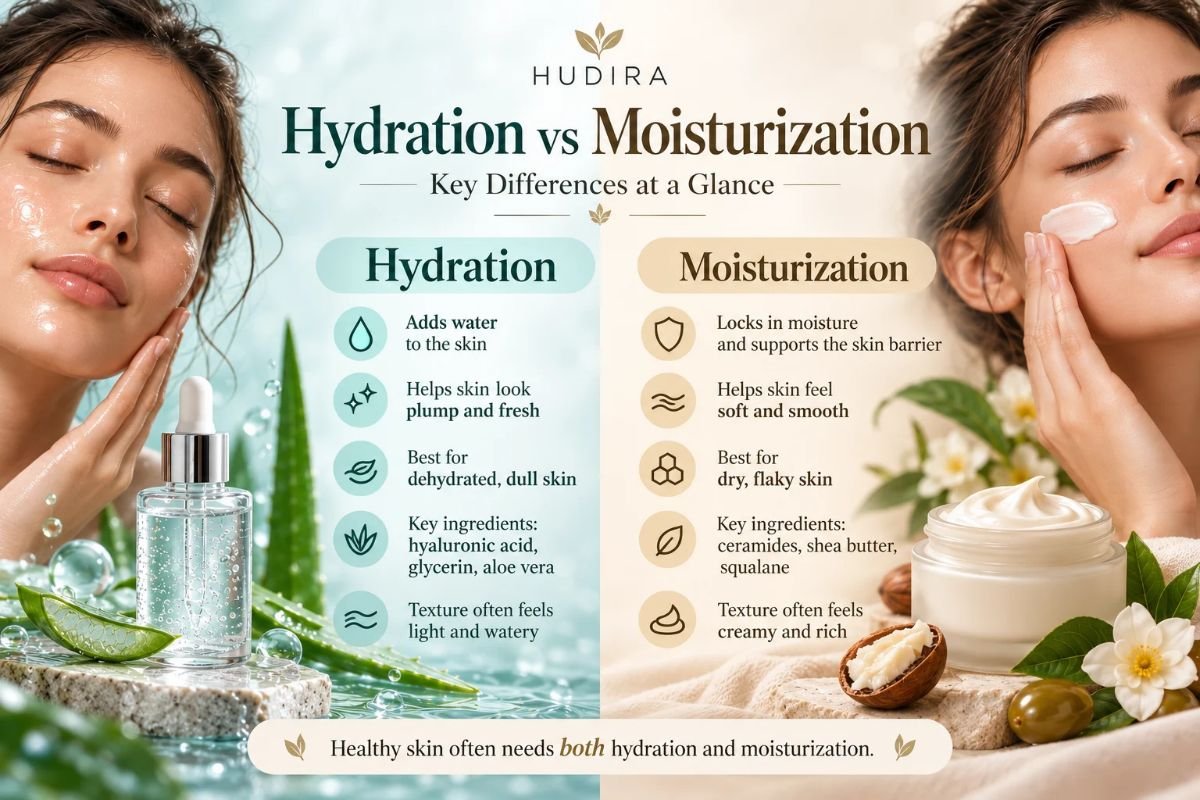
The simplest way to understand hydration vs moisturization is to think of hydration as supporting your skin’s water content and moisturization as helping your skin stay soft, comfortable, and protected against moisture loss.
Both are essential to healthy-looking skin, but they work in different ways.
Skin hydration refers to the water content of the skin, particularly its outermost layer. Hydrating ingredients, called humectants, attract and bind water, helping skin appear smoother, plumper, and more supple.
Moisturization, on the other hand, involves supporting the skin’s protective barrier, softening rough areas, and reducing excessive water loss. Moisturizers often contain a combination of humectants, emollients, and occlusives.
Here’s an easy comparison:
| Skin Hydration | Skin Moisturization |
| Focuses on maintaining water content | Focuses on softness and barrier protection |
| Helps skin look plump and supple | Helps reduce dryness and roughness |
| Often involves humectants | Often combines humectants, emollients, and occlusives |
| Common ingredients include glycerin and hyaluronic acid | Common ingredients include ceramides, shea butter, and petrolatum |
| Benefits oily, dry, and combination skin | Benefits all skin types when the formulation is suitable |
The important takeaway? You don’t necessarily need separate products for both purposes. A well-formulated moisturizer can support hydration and help retain moisture at the same time.
Ultimately, hydration vs moisturization isn’t about choosing a winner. It’s about understanding how these two functions work together.
What Is Skin Hydration, and Why Is It Important?
Think of your skin as a delicate protective shield. When it contains an appropriate amount of water, it can feel flexible, comfortable, and smooth. When its water content decreases, it may appear dull or develop a tight sensation.
This is where skin hydration becomes important.
Hydrating ingredients help bind water within the outer layers of your skin. As a result, properly hydrated skin often looks more supple, and fine lines caused by temporary dehydration may appear less noticeable.
Benefits of Proper Skin Hydration
Maintaining skin hydration can help:
- Improve the appearance of skin plumpness and smoothness.
- Reduce the tight feeling associated with dehydrated skin.
- Support the flexibility of the outer skin layer.
- Make temporary dehydration lines less noticeable.
- Promote a more comfortable, refreshed-looking complexion.
However, hydration isn’t simply about splashing water on your face.
Water alone evaporates, and frequent exposure to water or harsh cleansing can sometimes make dryness worse. To hydrate skin effectively, you need ingredients that help attract and retain water, along with suitable barrier protection.
Best Ingredients to Hydrate Skin
Hyaluronic acid: A humectant that binds water and can temporarily improve the skin’s plump appearance.
Glycerin: A widely used humectant that attracts water and supports hydration in many different skincare formulations.
Panthenol: Also known as provitamin B5, this ingredient helps support skin hydration and comfort.
Aloe vera: Often used in soothing skincare products. Its moisturizing effects depend on the complete formulation, concentration, and supporting ingredients.
Sodium PCA: A water-binding ingredient associated with the skin’s natural moisturizing factors.
The secret isn’t necessarily choosing the most expensive hydrating serum. It is selecting effective ingredients in a formulation that suits your skin.
What Is Moisturization, and Why Does Your Skin Need It?
Imagine filling a container with water but leaving its lid open. Over time, some of the water escapes. Your skin also loses water naturally through a process called transepidermal water loss (TEWL). A healthy skin barrier helps regulate this process.
This is why moisturizing skin matters. The outermost layer of your skin contains cells surrounded by lipids, including ceramides, cholesterol, and fatty acids. These components help maintain a protective barrier.
Moisturizers can soften rough skin, replenish or support barrier components, and reduce moisture loss, depending on their ingredients.
Benefits of Moisturizing Skin
A suitable moisturizer can:
- Reduce the appearance of dry, flaky patches.
- Improve skin softness and comfort.
- Help limit excessive water loss.
- Support the skin’s protective barrier.
- Reduce tightness caused by dryness.
- Improve the overall feel and appearance of rough skin.
For people seeking moist skin that feels naturally soft rather than greasy, choosing the right moisturizer texture is essential.
Lightweight lotions and gels may be comfortable for oily skin, while richer creams and ointments may work better for very dry areas.
Key Moisturizing Ingredients
Ceramides: Lipids naturally found in the skin barrier that help maintain its protective function.
Shea butter: A plant-derived ingredient rich in fatty components that can act as an emollient and help soften skin.
Squalane: A lightweight emollient that helps improve smoothness without necessarily creating a heavy feeling.
Petrolatum: An effective occlusive ingredient that helps reduce water loss and protect very dry skin.
Plant oils: Certain oils, such as sunflower seed oil, can contribute to softness and barrier support, although their benefits depend on the oil and formulation.
The goal of moisturizing skin isn’t to make your face excessively oily. It’s to maintain comfort and an effective protective barrier.
The Science Behind Hydration vs Moisturization: How Your Skin Holds Water
Your skin does something remarkable every day: it helps keep moisture inside while protecting you from the outside world. Most of this work happens in the outermost layer of the epidermis, called the stratum corneum.
Think of this layer as a brick wall. The skin cells are the bricks, while surrounding lipids act like mortar. Together, they form a barrier that helps prevent excessive water loss. Inside this structure, substances known as natural moisturizing factors (NMFs) help attract and retain water.
When the barrier is disrupted, the skin may lose water more readily. The result can be dryness, tightness, irritation, or flaking. This explains why moisturising and hydrating ingredients are often most effective when used together. Humectants help attract water. Emollients smooth and soften. Occlusives help reduce evaporation.
Humectants vs Emollients vs Occlusives
| Ingredient category | Main function | Common examples |
| Humectants | Attract and bind water | Glycerin, hyaluronic acid, panthenol |
| Emollients | Soften and smooth skin | Squalane, shea butter, selected plant oils |
| Occlusives | Form a protective layer that reduces water loss | Petrolatum, mineral oil, dimethicone |
Some ingredients have more than one function, and many moisturizers combine all three categories.
This is an important detail in understanding hydration vs moisturization: skin care is not simply about adding water or oil. It is about supporting a balanced, functioning skin barrier.
Dry Skin vs Dehydrated Skin: How Can You Tell?
One of the most confusing skincare questions is whether dry skin and dehydrated skin are the same.
They aren’t exactly the same, although their symptoms often overlap.
Dry skin generally describes skin with insufficient surface lipids or an impaired ability to retain moisture. It may be associated with skin type, environmental conditions, cleansing habits, aging, or skin conditions.
Dehydrated skin is a commonly used skincare term for skin with reduced water content. It can occur alongside dry or oily skin.
Understanding this distinction helps explain why the discussion about hydration vs moisturization matters.
Signs Commonly Associated With Dry Skin
- Rough or flaky patches.
- Persistent dryness or tightness.
- A dull or uneven-looking surface.
- Skin that becomes uncomfortable after cleansing.
- Occasional itchiness.
Signs Commonly Associated With Dehydrated Skin
- Temporary tightness.
- A dull or tired appearance.
- Fine lines that appear more noticeable.
- Skin that feels less supple.
- Discomfort after using overly drying products.
These signs are not reliable enough to diagnose dehydration on their own. Persistent redness, cracking, itching, or painful irritation may indicate a condition that requires professional evaluation.
Moisturized Skin vs Dry Skin: What’s the Visible Difference?
When comparing moisturized skin vs dry skin, the most noticeable differences are often texture and comfort.
Well-moisturized skin generally feels softer, smoother, and less tight, while dry skin may appear rough, flaky, or irritated.
But remember: healthy moist skin does not have to look shiny. A comfortable, balanced complexion is a better goal than an excessively glossy finish.
Can Oily Skin Also Be Dehydrated?
Absolutely.
Oil and water are different components of your skin’s condition. Your skin can produce plenty of sebum while still experiencing reduced water content or barrier disruption.
This is why an oily complexion doesn’t automatically mean you should skip moisturizer. If your skin feels oily on the surface but tight after cleansing, consider whether harsh cleansers, excessive exfoliation, or unsuitable products may be contributing to the problem.
A lightweight, non-comedogenic moisturizer containing humectants may help maintain comfort without feeling heavy.
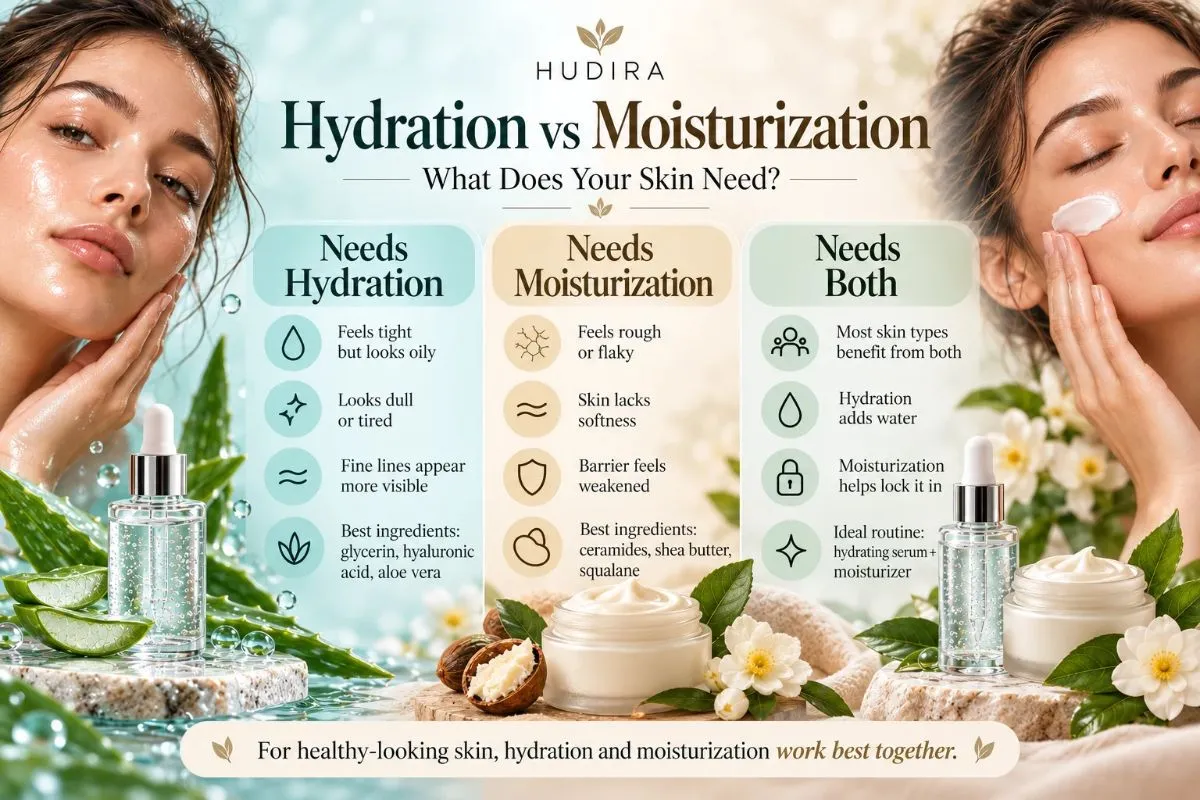
Hydration vs Moisturization: Does Your Skin Need One or Both?
Here’s the reassuring truth: most skin types benefit from products that provide both water-binding and barrier-supporting ingredients.
However, the type of product you choose should depend on your skin’s needs.
1. Dry Skin
Look for creams containing humectants alongside emollients and occlusives.
Ingredients such as glycerin, ceramides, shea butter, and petrolatum can be useful, depending on your tolerance and the product.
2. Oily Skin
Choose lightweight, non-comedogenic moisturizers that provide skin hydration without an unnecessarily heavy finish.
Gel creams and lotions containing glycerin or hyaluronic acid can be good options.
3. Combination Skin
Different areas of your face may need different textures.
For example, a lightweight lotion may feel comfortable across the face, while a richer cream can be applied to especially dry areas.
4. Sensitive Skin
Prioritize gentle, fragrance-free products with simple formulations.
Avoid assuming a botanical ingredient is automatically gentle. Essential oils and plant extracts may irritate sensitive skin.
5. Mature Skin
With age, the skin may become drier and more vulnerable to barrier disruption.
Products combining humectants, emollients, and barrier-supporting ingredients can help maintain softness and comfort.
Whatever your skin type, the goal is to achieve moist skin that feels balanced, not overloaded with products.
How to Hydrate and Moisturize Your Face: A Simple Daily Routine
You don’t need an overwhelming ten-step routine to care for your skin. In fact, consistency and suitable products are often more valuable than a crowded bathroom shelf.
Here’s a practical approach to hydration for face care that combines hydration and barrier support.
Morning Routine: Protect and Refresh
Step 1: Cleanse gently.
Use a mild cleanser that removes overnight buildup without leaving your skin uncomfortable. Some very dry or sensitive skin types may only need a gentle water rinse in the morning.
Step 2: Apply an optional hydrating product.
If your skin benefits from additional hydration, use a serum containing glycerin, hyaluronic acid, or another suitable humectant.
Applying it to slightly damp skin may feel comfortable and help distribute the product.
Step 3: Moisturize.
Choose a moisturizer suited to your skin type. This step helps maintain softness and reduce excessive moisture loss.
Step 4: Apply sunscreen.
Finish with a broad-spectrum SPF 30 or higher sunscreen. Sunscreen is essential for reducing UV-related skin damage and premature aging.
Evening Routine: Cleanse and Replenish
Step 1: Remove sunscreen, makeup, and daily buildup with gentle cleansing.
Step 2: Apply a hydrating serum if needed.
Step 3: Follow with a moisturizer that provides appropriate humectants and barrier-supporting ingredients.
Step 4: Apply a richer product to very dry areas when necessary.
When building a routine, many people ask whether to hydrate vs moisturize first.
If you’re using separate products, a water-based hydrating serum generally goes before a cream-based moisturizer. However, a well-formulated moisturizer alone may be enough.
The best routine for moisturizing skin is one you can follow comfortably and consistently.
How to Keep Your Skin Hydrated in Different Weather Conditions
Environmental conditions can influence how your skin feels.
Hot weather, cold temperatures, low humidity, and indoor climate control can all affect skin comfort.
During Hot and Humid Weather
Choose lightweight, non-greasy products if heavier creams feel uncomfortable. A gel-cream moisturizer can support skin hydration without leaving a thick residue.
Avoid washing your face repeatedly just because it feels oily. Over-cleansing can increase irritation and dryness.
During Winter
Cold outdoor air and dry indoor heating may increase moisture loss.
Use a richer moisturizer when needed, shorten hot showers, and avoid harsh cleansing products.
In Air-Conditioned Environments
Long periods in dry indoor air may leave skin feeling tight.
Applying moisturizer after cleansing, while the skin is still slightly damp, can help maintain comfort. A humidifier may also be helpful in very dry environments when used and cleaned properly.
If your goal is to hydrate skin throughout the day, focus on a consistent routine rather than constantly layering new products.
Five Common Hydration and Moisturization Mistakes to Avoid
Even with an expensive skincare collection, a few common habits can leave your skin feeling uncomfortable.
Mistake 1: Assuming Oily Skin Doesn’t Need Moisturizer
Oily skin can still experience dryness or dehydration.
Choose a lightweight formula instead of abandoning moisturizer altogether.
Mistake 2: Using Hot Water Excessively
Very hot water and long showers can aggravate dry skin.
Lukewarm water and gentle cleansing are better choices for maintaining comfort.
Mistake 3: Confusing Drinking Water With Topical Hydration
Drinking enough water supports overall health and is essential when you’re dehydrated.
However, drinking excessive water has not been shown to replace the benefits of appropriate topical skincare in otherwise adequately hydrated people.
Mistake 4: Exfoliating Too Frequently
Over-exfoliation may disrupt the skin barrier and contribute to sensitivity, redness, or tightness.
If your skin becomes irritated, reduce exfoliation and focus on gentle cleansing and moisturizing.
Mistake 5: Using Products Based Only on Marketing Claims
Words like intensely hydrating, deeply moisturizing, or all-natural do not guarantee that a product suits your skin.
Learning about hydration vs moisturization helps you look beyond attractive packaging and make informed decisions.
Discover the Beauty of Botanical Skincare With HUDIRA
Your skin deserves more than complicated promises. It deserves thoughtful care, useful knowledge, and products chosen with intention.
At HUDIRA, we’re inspired by the beauty of botanical ingredients and the belief that skincare should feel like a nurturing ritual. If you enjoy botanical skincare rituals, explore HUDIRA’s Orange Glow Face Mask, made with a blend of traditional plant-derived ingredients and designed as a complement to your skincare routine.
Our plant-powered face masks bring traditional ingredient inspiration into everyday self-care. Whether you’re refreshing your routine or exploring natural skincare for the first time, we’re here to help make that journey feel simple and enjoyable.
Ready to discover a little botanical glow?
Explore HUDIRA’s Organic & Botanical Skincare Collection and find a face mask that complements your skincare routine.
Glow Naturally, Heal Gently — The HUDIRA Way.
FAQs
Q. What’s the difference between hydrating and moisturizing?
The main difference is that hydrating ingredients help attract and bind water, while moisturizing products help soften skin and reduce moisture loss. Many moisturizers perform both functions by combining humectants, emollients, and occlusives. For most skin types, hydration and barrier support work best together.
Q. In moisturizer vs hydrator, which one should I use first?
In a moisturizer vs hydrator routine, apply a lightweight water-based hydrating serum first, followed by a cream or lotion if both products are needed. However, many moisturizers already contain effective hydrating ingredients, so using a separate serum is optional rather than essential.
Q. Can I use natural oils instead of moisturizer to hydrate my skin?
Natural oils can act as emollients and may help reduce moisture loss, but they don’t necessarily provide the same water-binding benefits as humectants. If your skin feels dehydrated, choose a balanced formulation containing both water-binding and barrier-supporting ingredients. Oils alone aren’t always sufficient.
Q. How often should I moisturize my face for healthy skin hydration?
For many people, moisturizing twice daily after morning and evening cleansing is a practical approach. Apply moisturizer while your skin is slightly damp when appropriate. Adjust the frequency and product texture according to your skin’s needs, climate, and sensitivity. Consistent care can support comfortable, healthy-looking skin.
Add comment