
No products in the cart.

Have you ever looked in the mirror and noticed black skin around lips, even though the rest of your face looks clear and radiant? That stubborn shadow above your mouth can be frustrating, especially when makeup barely conceals it. Whether you’re dealing with a black upper lip, uneven pigmentation around mouth, or a dark upper lip that seems to get more noticeable, understanding the cause is the first step toward healthier-looking, more even-toned skin.
But what if the secret to improving that unwanted darkness isn’t another harsh brightening cream? Some natural ingredients may soothe irritated skin, support its protective barrier, and complement a gentle skincare routine. However, not every popular home remedy actually fades pigmentation. Let’s discover six natural remedies for dark upper lip area, which ones deserve your attention, and the surprising everyday habits that might be making the darkness worse.
Why Does Black Skin Around Lips Appear?
The skin around your mouth is constantly exposed to sunlight, facial movements, cosmetic products, and environmental stressors. Consequently, this delicate area can develop noticeable changes in color.
One of the main reasons is hyperpigmentation, which occurs when the skin produces or retains excess melanin, the natural pigment responsible for skin color.
Although a dark upper lip is usually a cosmetic concern, understanding its underlying cause matters because different types of pigmentation respond to different treatments.
1. Excessive Sun Exposure
Sun exposure is a significant trigger for facial pigmentation. Ultraviolet radiation stimulates melanin production, while visible light can contribute to pigmentation, particularly in darker skin tones.
As a result, spending time outdoors without adequate protection may make existing pigmentation around mouth more noticeable. Even short, repeated periods of exposure can contribute to persistent discoloration.
2. Hormonal Changes and Melasma
Hormonal fluctuations during pregnancy, with certain contraceptives, or alongside other hormonal influences can contribute to melasma.
Melasma produces brown or gray-brown patches, frequently affecting the cheeks, forehead, and upper-lip area. When pigmentation develops above the lip, it is sometimes called a melasma mustache.
A black upper lip caused by melasma may require more than traditional home remedies because the condition can be persistent and recurring.
3. Irritation From Waxing or Threading
Regular hair removal can irritate sensitive skin, particularly when waxing is too hot, repeated frequently, or performed over already inflamed areas.
This irritation may trigger post-inflammatory hyperpigmentation, leaving brown or dark patches after the initial redness settles.
If you notice a dark upper lip after hair removal, consider switching to a gentler technique and giving your skin time to recover.
4. Harsh Skincare Products
Strong exfoliants, fragranced cosmetics, irritating lip products, and repeated rubbing may contribute to inflammation.
Over time, persistent irritation can make pigmentation around mouth more difficult to manage.
Interestingly, trying too many brightening products simultaneously may actually worsen the appearance of dark patches.
5. Skin Conditions and Other Factors
Eczema, contact dermatitis, acne, and other inflammatory skin conditions can leave lingering pigmentation.
Occasionally, nutritional deficiencies, medications, or medical conditions may also contribute to unusual discoloration.
However, not every black upper lip is caused by excess pigment. Facial hair, visible hair follicles, or natural shadows can create a similar appearance.
If discoloration appears suddenly, changes rapidly, affects the mouth’s lining, or comes with other symptoms, consult a healthcare professional.
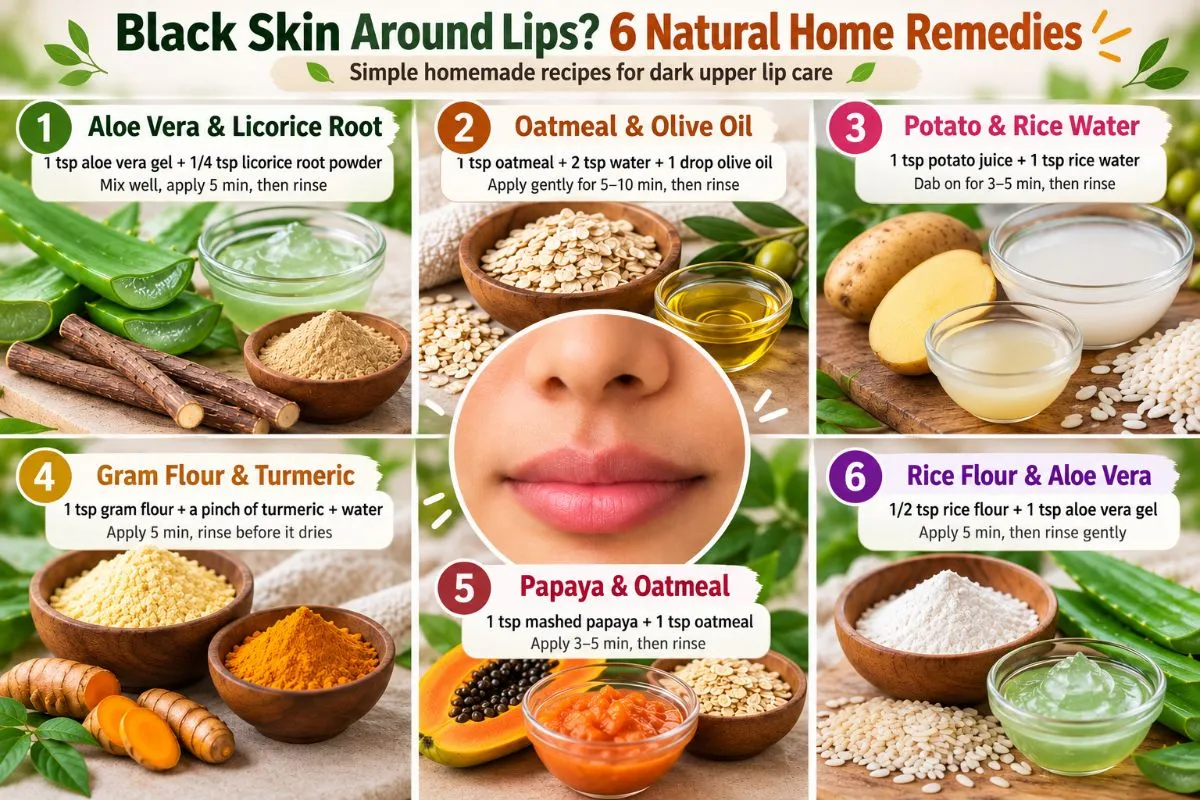
6 Natural Remedies for Dark Upper Lip Area
Dealing with black skin around lips can feel frustrating, especially when a stubborn shadow makes your upper lip look darker than the surrounding skin. From sun exposure and hormonal fluctuations to waxing-related irritation, several factors can contribute to pigmentation around mouth. Fortunately, gentle homemade skincare recipes may help support skin comfort and prevent additional irritation.
Before trying these natural remedies for dark upper lip area, remember that household ingredients cannot reliably remove established melasma or hyperpigmentation. However, choosing soothing ingredients and avoiding harsh scrubbing can support healthier-looking skin.
1. Aloe Vera0]
and Licorice Root Mask for Dark Upper Lip
Licorice root contains glabridin and liquiritin, compounds investigated for their potential influence on skin pigmentation. Aloe vera is valued for its hydrating and soothing properties.
Ingredients:
- 1 teaspoon plain aloe vera gel
- ¼ teaspoon finely powdered licorice root
- A few drops of clean water, if needed
How to prepare:
- Combine the aloe vera gel and licorice powder in a clean bowl.
- Mix until a smooth paste forms.
- Perform a patch test before facial use.
- Apply a thin layer to the intact skin above the upper lip.
- Leave for approximately five minutes, then rinse gently.
How often: Start with once weekly if tolerated.
Important: Homemade licorice powder has not been shown to produce the same results as standardized extracts.
2. Oatmeal and Olive Oil Mask for Black Upper Lip Care
Dryness, friction, and repeated irritation can make existing dark marks more noticeable. Oatmeal offers soothing benefits, while olive oil acts as an emollient.
Ingredients:
- 1 teaspoon finely milled colloidal oatmeal
- 2 teaspoons clean water
- 1 drop olive oil, optional
How to prepare:
- Mix the oatmeal and water into a soft paste.
- Add a drop of olive oil only if your skin tolerates it.
- Apply gently to clean upper-lip skin.
- Leave for 5–10 minutes.
- Rinse without rubbing or exfoliating.
How often: Once or twice weekly.
Important: Olive oil can aggravate the skin barrier in some people, especially those with eczema. Omit it if you have sensitive or reactive skin.
3. Potato and Rice Water Compress for Upper Lip Darkness
Potato and rice water are familiar ingredients in traditional beauty routines. Although they are often promoted for skin brightening, there is insufficient clinical evidence that either removes upper-lip pigmentation.
Ingredients:
- 1 teaspoon freshly prepared potato juice
- 1 teaspoon freshly prepared rice-soaking water
- A clean, soft cotton pad
How to prepare:
- Wash and grate a small potato, then extract a little juice.
- Rinse uncooked rice, soak it briefly in clean water, and collect the liquid.
- Combine equal amounts of the two liquids.
- Patch-test before use.
- Apply gently to intact upper-lip skin for 3–5 minutes.
- Rinse and moisturize.
How often: Occasional use only.
Prepare it fresh and discard any leftovers.
4. Gram Flour and Turmeric Mask for Pigmentation Around Mouth
Gram flour, also known as besan, is a familiar ingredient in South Asian beauty traditions. Turmeric contains curcumin, which has been studied for its antioxidant and anti-inflammatory properties.
Ingredients:
- 1 teaspoon finely sifted gram flour
- A tiny pinch of turmeric
- Enough clean water to make a smooth paste
How to prepare:
- Add gram flour and turmeric to a clean bowl.
- Gradually mix in water until smooth.
- Patch-test the mixture first.
- Apply a thin layer to the dark upper-lip area.
- Leave for approximately five minutes.
- Rinse before the paste dries completely.
How often: Once weekly if tolerated.
Important: Never scrub off dried gram flour. Excessive friction may worsen post-inflammatory pigmentation, and turmeric can temporarily stain the skin.
5. Ripe Papaya and Oatmeal Mask for Dark Upper Lip Care
Papaya contains papain, an enzyme that breaks down proteins. Although papain has been used in exfoliating skincare, fresh papaya is not standardized and may irritate delicate skin.
Ingredients:
- 1 teaspoon mashed ripe papaya
- 1 teaspoon finely milled colloidal oatmeal
- A few drops of water, if needed
How to prepare:
- Mash ripe papaya until smooth.
- Mix with finely milled oatmeal.
- Patch-test carefully before applying.
- Spread a thin layer over intact upper-lip skin.
- Leave for no more than 3–5 minutes.
- Rinse gently and apply moisturizer.
How often: Occasional use only, if tolerated.
Important: Avoid papaya masks if you have sensitive, inflamed, recently waxed, or damaged skin, or a papaya or latex allergy.
6. Rice Flour and Aloe Vera Mask for Uneven Upper Lip Skin Tone
Rice-derived ingredients are popular in traditional skincare, while aloe vera provides moisturizing and soothing properties.
This combination offers a gentle alternative to abrasive DIY exfoliating masks when applied without rubbing.
Ingredients:
- ½ teaspoon very finely ground rice flour
- 1 teaspoon plain aloe vera gel
- A little clean water, if necessary
How to prepare:
- Mix rice flour and aloe vera gel in a clean bowl.
- Add a few drops of water until the paste becomes smooth.
- Patch-test before applying.
- Apply gently to the skin above your upper lip.
- Leave for approximately five minutes.
- Rinse carefully without massaging or scrubbing.
How often: Once weekly if tolerated.
Which Natural Remedy Is Best for Dark Upper Lip?
Homemade remedy | Main potential benefit | Pigmentation-fading evidence |
| Aloe vera and licorice | Soothing; licorice compounds studied for pigmentation | Limited for homemade mixture |
| Oatmeal and olive oil | Dryness and skin comfort | Not established |
| Potato and rice water | Temporary hydration | Insufficient |
| Gram flour and turmeric | Traditional cleansing and antioxidant ingredients | Limited |
| Papaya and oatmeal | Potential surface exfoliation | Unproven; irritation risk |
| Rice flour and aloe vera | Gentle skin care and hydration | Insufficient |
Important Tips to Prevent Dark Upper Lip Pigmentation
If you want to reduce black skin around lips, preventing additional skin irritation is essential.
- Apply broad-spectrum SPF 30 or higher sunscreen every morning. For melasma, tinted sunscreen containing iron oxides may offer additional protection.
- Avoid lemon juice, abrasive scrubs, baking soda, and undiluted essential oils.
- Never apply homemade masks to broken, inflamed, or freshly waxed skin.
- Patch-test each recipe and discontinue immediately if irritation develops.
- Avoid combining multiple remedies in a single session.
- Seek dermatological advice for persistent or worsening pigmentation.
The key takeaway: Natural home remedies may support a gentle skincare routine, but treating the underlying cause and protecting the skin from sunlight are far more important for lasting improvement.
How to Remove Darkness Around Mouth Naturally With a Simple Daily Routine
You don’t need a complicated ten-step ritual to care for a dark upper lip.
In fact, a minimal routine may be particularly helpful if previous products caused irritation.
Morning Routine: Protect and Prevent
Step 1 — Cleanse gently
Wash your face using a mild, non-abrasive cleanser. Avoid hot water and excessive rubbing.
Step 2 — Apply a suitable moisturizer
Look for ingredients that support the protective skin barrier, such as glycerin, ceramides, or colloidal oatmeal.
Step 3 — Use sunscreen
Finish with broad-spectrum SPF 30 or higher. Tinted formulas containing iron oxides are especially useful for people managing melasma.
Don’t forget the small strip of skin above your lip.
Evening Routine: Nourish and Restore
Step 1 — Remove makeup and sunscreen
Use a gentle cleanser without aggressive scrubbing.
Step 2 — Apply your chosen skincare product
If you’re using a licorice-containing product or another targeted treatment, follow its directions rather than combining several active products.
Step 3 — Moisturize
A gentle moisturizer can help reduce dryness and maintain skin comfort overnight.
Step 4 — Give your skin time
Consistency matters more than constantly changing products.
If pigmentation persists, a dermatologist may recommend treatments with better clinical evidence, such as azelaic acid or other appropriate medications.
How Long Does It Take for a Black Upper Lip to Improve?
Patience is essential when managing discoloration. The timeline depends on the cause, the depth of pigmentation, your natural skin tone, and whether irritating triggers continue.
For instance, pigmentation that develops after mild inflammation may gradually fade once the underlying irritation stops.
According to the American Academy of Dermatology, superficial dark spots can sometimes require six to twelve months to fade, while deeper pigmentation may take much longer.
Melasma can be especially persistent. It may improve with treatment but can return after sun exposure or hormonal changes.
Embrace Gentle Botanical Skincare With Hudira
Beautiful skin doesn’t require aggressive treatments or unrealistic whitening promises.
At Hudira, we believe skincare should celebrate your natural complexion while encouraging thoughtful care inspired by botanical traditions.
If you’re exploring plant-based skincare for dullness and uneven tone, discover Hudira’s Brightening Face Mask, featuring a botanical blend that includes rose, turmeric, saffron, neem, and other herbal ingredients.
Designed as part of a beauty routine focused on caring for the skin, this mask offers a way to enjoy traditional botanical ingredients without relying on harsh DIY scrubs.
Ready to give your skincare routine a gentle botanical touch?
Explore Hudira’s organic-inspired skincare collection and discover the Hudira Brightening Face Mask.
Let your skincare journey be about nourishment, confidence, and celebrating the natural beauty that’s already yours.
FAQs
Q. How to get rid of dark skin around lips naturally?
Start by identifying possible causes, such as sunlight, irritation, or melasma. Use gentle cleansing, daily moisturizer, and broad-spectrum SPF 30 or higher. Aloe vera or colloidal oatmeal may provide soothing support, while some properly formulated botanical ingredients show preliminary pigmentation-related potential. However, home remedies cannot guarantee that dark pigmentation will disappear.
Q. Can aloe vera help reduce pigmentation around mouth?
Aloe vera may soothe irritated skin and support hydration. Some aloe-derived compounds have been studied for pigmentation effects, but evidence that ordinary aloe vera gel reliably lightens facial hyperpigmentation is limited. Use a fragrance-free formulation and patch-test before applying.
Q. Why is my black upper lip getting darker despite skincare?
A black upper lip may continue darkening because of unprotected sun exposure, melasma, repeated waxing, irritation, or unsuitable skincare products. Facial hair can also create the appearance of a dark shadow. If the cause is unclear or the discoloration keeps changing, consult a dermatologist.
Q. Can turmeric remove dark upper lip pigmentation permanently?
There is insufficient clinical evidence that homemade turmeric masks permanently remove a dark upper lip. Turmeric contains compounds with antioxidant and anti-inflammatory properties, but these do not guarantee reduced melanin production in human skin. Avoid irritating mixtures and prioritize sunscreen and suitable treatments.
Q. What is the best daily routine for black skin around lips?
A simple routine includes gentle cleansing, moisturizing, and applying SPF 30 or higher every morning. For persistent pigmentation, tinted sunscreen containing iron oxides may be especially helpful. At night, cleanse gently, moisturize, and use any prescribed or carefully selected treatment as directed. Avoid scrubbing and irritating DIY remedies.
Add comment