
No products in the cart.

That uncomfortable tight face after washing can make even the simplest skincare routine feel frustrating. Your cheeks may feel stretched, your forehead may feel dry, or your face stings the moment water evaporates. Sometimes, the face feeling tight after washing even though it looked completely normal beforehand. While that squeaky-clean sensation is often mistaken for proof that your cleanser worked well, it may actually be your skin asking for more gentle care.
So, what is really happening after cleansing? Is the cleanser too harsh, is your skin dehydrated, or could you simply be washing too often? And why does a stinging face sometimes appear even when you are using products labeled “gentle”? The surprising answer lies in your skin barrier—the invisible protective layer responsible for holding moisture in and keeping irritants out. Once you understand what is disturbing it, restoring comfort naturally becomes much easier.
Why Is Your Face Feeling Tight After Washing?

A face feeling tight after washing usually because your skin has temporarily lost some of the water, oils, or protective substances it needs to stay comfortable.
The outermost layer of your skin is called the stratum corneum. Think of it like a protective wall. Skin cells form the “bricks,” while natural lipids including ceramides, cholesterol, and fatty acids help form the “mortar.”
Together, these components reduce water loss and protect your skin from environmental irritation.
During cleansing, surfactants in facial cleansers loosen sunscreen, oil, makeup, sweat, and dirt so they can be rinsed away. This is an important part of cleansing. However, a cleanser that is too aggressive for your skin or simply used too frequently may also disturb some of the skin’s protective lipids and natural moisturizing components.
As water evaporates after cleansing, an irritated or dehydrated outer layer can become less flexible. This helps explain why the skin feels tight after washing, especially when smiling, talking, or moving your face.
If your face stings as well, irritation may be playing a bigger role.
Tight Skin, Dry Skin, or Dehydrated Skin: What’s the Difference?
These terms are often used interchangeably, but they don’t mean exactly the same thing.
| Skin concern | What it generally means | Common signs |
| Dry skin | Skin produces or retains insufficient lipids | Flaking, roughness, dullness |
| Dehydrated skin | Skin lacks adequate water | Tightness, fine dehydration lines, dull appearance |
| Tight skin | A sensation rather than a skin type | Stretching, discomfort, stiffness |
| Irritated skin | Skin barrier is disturbed or exposed to an irritant | Redness, burning, sensitivity, stinging |
Your skin feels tight after washing if it becomes dehydrated temporarily, but naturally dry skin may experience the sensation more frequently. Likewise, oily skin can still be dehydrated. Having visible oil does not guarantee that your skin is holding enough water.
A stinging face may suggest something beyond ordinary dryness, particularly when accompanied by redness, peeling, itching, or burning.
Does Tightness Mean Your Face Is Really Clean?
No. Tightness is not a reliable measure of cleanliness.
Many people grew up believing that skin should feel squeaky clean after cleansing. Unfortunately, that sensation can sometimes indicate that the cleansing routine is removing more than dirt and excess oil.
A properly cleansed face should generally feel comfortable rather than painfully dry, stretched, or irritated.
If your face stings every time you cleanse, don’t assume that stronger cleansing is solving the problem. In fact, continuously stripping the skin can make sensitivity more noticeable.
The goal is not to leave every trace of natural oil behind, nor is it to remove every possible lipid from your skin. Effective cleansing means removing unwanted buildup while preserving enough barrier function for your skin to feel balanced.
7 Reasons Your Skin Feels Tight After Washing
Understanding the cause is the first step toward fixing a face feeling tight after washing naturally.
1. Your Cleanser May Be Too Harsh
Cleansers contain surfactants that allow oil-based impurities to mix with water and rinse away. Different surfactant systems behave differently. Some cleansers are extremely mild, while others can be more drying, particularly when they are used frequently or on already sensitive skin.
If your skin feels tight after washing, reconsider whether your cleanser matches your current skin condition, not just your usual skin type. Someone with typically oily skin can still develop temporary sensitivity or dehydration.
2. You’re Using Water That Is Too Hot
Hot water can feel relaxing, but very hot water may increase dryness and make irritated skin feel worse. For most people, lukewarm water is a better choice for facial cleansing.
If your face stings immediately when hot water touches it, lower the temperature and observe whether your comfort improves.
3. You May Be Cleansing Too Frequently
Can you wash your face too much?
Yes. Cleansing repeatedly throughout the day may become irritating, particularly if you use strong cleansers each time.
Most people do not need to scrub their face every few hours. If the skin feels tight after washing several times per day, reducing unnecessary cleansing may help your barrier recover.
4. You Are Over-Exfoliating
Exfoliating acids, scrubs, peels, retinoids, and other active products can be useful when used appropriately.
But combining too many treatments or using them too frequently may leave the skin more reactive after cleansing. A stinging face after applying normal moisturizer or water can be a warning that your routine needs simplifying.
5. Your Skin Barrier Is Already Compromised
Cold weather, dry indoor air, excessive exfoliation, irritating cosmetics, sun exposure, and certain skin conditions can weaken barrier function.
When that happens, even a cleanser you previously tolerated may suddenly cause discomfort. This is why a face feeling tight after washing sometimes appears without changing products.
6. You Wait Too Long to Moisturize
Water evaporates quickly from freshly cleansed skin. Applying moisturizer while your skin is still slightly damp can help trap hydration and reduce uncomfortable dryness.
If your skin feels tight after washing, try moisturizing shortly after gently patting away excess water instead of allowing your face to become completely dry first.
7. Hard Water May Contribute
Hard water contains higher levels of minerals such as calcium and magnesium. Research suggests hard water may increase the deposition of certain surfactants on the skin and may worsen irritation in susceptible people.
Hard water isn’t necessarily the cause for everyone, but it can be worth considering if your face stings regularly despite using a mild routine.
How to Fix Face Feeling Tight After Washing Naturally
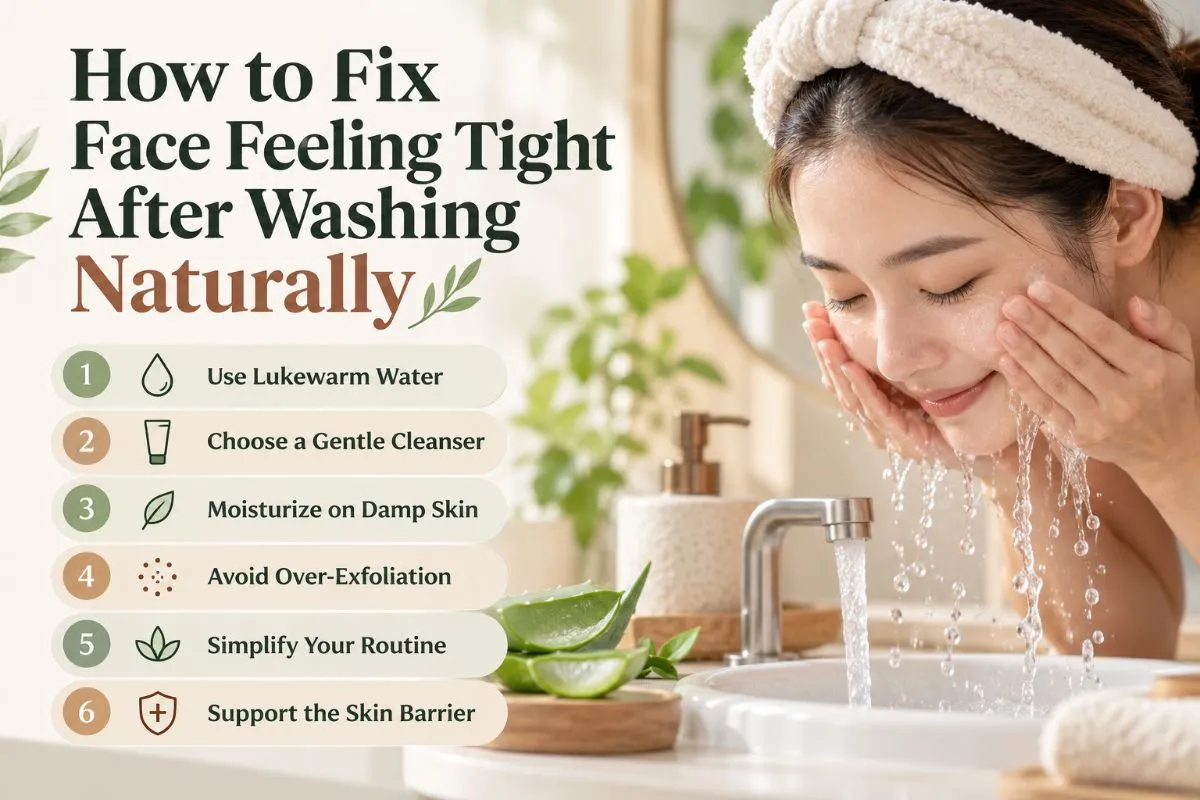
The good news is that a face feeling tight after washing does not always require a complicated 10-step routine.
In many cases, gentler habits and barrier-supportive ingredients make the biggest difference.
1. Wash With Lukewarm Water
Start with the easiest change. Avoid very hot water and rinse your face with comfortably lukewarm water instead.
Hot showers and steaming facial routines can feel luxurious, but excessive heat may worsen moisture loss and sensitivity. Keep cleansing brief and gentle.
2. Switch to a Mild Cleanser
A cleanser doesn’t have to produce huge amounts of foam to work. Look for formulas designed to cleanse without leaving the skin feeling stripped.
For sensitive or dry-feeling skin, a creamy, lotion-like, or gentle gel cleanser may feel more comfortable than a powerful degreasing cleanser.
3. Stop Scrubbing Your Face
Friction can make already irritated skin feel worse. Use clean fingertips rather than aggressively rubbing with rough washcloths, cleansing brushes, or grainy scrubs.
Massage gently, rinse thoroughly, and pat—not rub—the face dry. If your stinging face gets worse when you towel-dry, your skin may need an even softer approach.
4. Moisturize While Your Skin Is Slightly Damp
This is one of the simplest ways to improve hydration. After washing, gently pat away dripping water but leave a little moisture on your skin. Then apply your moisturizer.
Moisturizers typically combine ingredients that:
- attract water,
- soften rough skin,
- and reduce excessive evaporation.
This can be particularly helpful when the skin feels tight after washing.
5. Pause Strong Actives Temporarily
When your face stings, adding more acids, scrubs, peels, or highly concentrated treatments rarely makes sense. Give your skin a simpler routine for several days:
gentle cleanser → moisturizer → sunscreen during the day.
Once your skin feels comfortable again, you can gradually reintroduce suitable actives.
6. Choose Humectant-Rich Hydration
Humectants help attract water into the outer layers of the skin.
Glycerin is a particularly well-established moisturizing ingredient and works beautifully in both natural-inspired and conventional formulations.
Hyaluronic acid and panthenol may also support hydration depending on the formula.
Remember that humectants usually work best as part of a complete moisturizer rather than being treated as standalone miracle ingredients.
7. Support the Barrier With Emollients
Emollients help smooth gaps between surface skin cells and improve softness. Depending on your skin type and the formulation, useful ingredients can include:
- squalane,
- shea butter,
- sunflower seed oil,
- ceramides,
- fatty acids.
Plant oils can be valuable components of skincare, but they should still be selected carefully.
8. Consider Colloidal Oatmeal
Colloidal oatmeal has a long history of use in dry and irritated skin care and is supported by clinical research for helping improve hydration and skin-barrier comfort.
It can be especially appealing when your skin needs something soothing. However, choose properly formulated products rather than rubbing rough kitchen oats directly onto a stinging face.
9. Simplify Your Routine
When something goes wrong, people often add more products. Sometimes the more powerful move is to remove a few.
For several days, consider focusing only on:
- gentle cleansing,
- hydration,
- moisturizer,
- daily sun protection.
A minimal routine makes it easier to identify which product may be causing discomfort after cleansing.
What to Do Immediately If Your Face Stings After Washing
If your face stings right now, avoid panic and avoid throwing five new remedies on it at once.
Try this simple approach:
First: Stop scrubbing or washing repeatedly.
Second: Rinse away any cleanser residue using cool-to-lukewarm water.
Third: Pat gently with a soft towel.
Fourth: Apply a simple moisturizer that you already know your skin tolerates.
Fifth: Avoid exfoliating acids, retinoids, scrubs, fragranced products, or strong masks until the irritation settles.
A stinging face that improves quickly after changing your routine may simply have been irritated.
However, intense or persistent burning deserves more attention.
Natural Ingredients That May Help Tight, Dry Skin

Natural skincare can support a compromised barrier when ingredients are selected thoughtfully.
Colloidal Oatmeal
Colloidal oatmeal may help soothe dry, uncomfortable skin and support hydration. It is especially useful in professionally formulated creams, lotions, and cleansers designed for sensitive skin.
How to use: Choose a moisturizer, cleanser, or soothing mask formulated with colloidal oatmeal. Apply it to clean skin as directed, especially when your skin feels dry or uncomfortable after cleansing.
Sunflower Seed Oil
Sunflower seed oil is rich in linoleic acid and is commonly used as an emollient. It can help soften dry skin and support a moisturizer’s lipid phase.
How to use: Use a skincare product containing sunflower seed oil, or apply a very small amount of suitable cosmetic-grade oil over moisturizer to help seal in hydration. Patch test first, especially if your skin is acne-prone or sensitive.
Shea Butter
Shea butter provides rich emollience and may be useful for very dry skin. People with oily or acne-prone skin may prefer lighter textures, so formulation still matters.
How to use: Apply a small amount of a shea butter-containing moisturizer to dry areas after cleansing. It is best suited to very dry skin or used as the final moisturizing layer when extra softness is needed.
Squalane
Squalane is a lightweight emollient widely used to reduce roughness and improve softness without the heavy feel of some oils.
How to use: Apply two or three drops of cosmetic-grade squalane after moisturizer, or use a cream or serum that already contains it. It can work particularly well in the evening when the skin feels tight after washing.
Aloe Vera
Aloe vera is popular for its cooling, soothing feel. However, raw plant material isn’t necessarily better than a properly formulated product, and some people can still react to botanical ingredients.
How to use: Apply a thin layer of a fragrance-free aloe vera gel or an aloe-containing moisturizer to clean skin. Follow with moisturizer if your skin is dry, since aloe alone may not provide enough occlusion to prevent moisture loss.
Patch testing is sensible when trying something new.
Why Does My Face Feel Tight Even Though I Have Oily Skin?
The answer is simple: oil and water are different.
Your skin can produce plenty of sebum while still lacking adequate water in the outer layers. Over-cleansing oily skin may also increase irritation and dehydration, which is why the skin feels tight after washing even if shine returns later.
Rather than using stronger cleansers automatically, focus on balancing effective cleansing with hydration.
When Does Tight or Stinging Skin Need Professional Help?
Occasional mild tightness usually improves once irritating habits are corrected.
However, seek professional advice if the discomfort is persistent or accompanied by:
- strong burning,
- significant redness,
- swelling,
- cracked or bleeding skin,
- persistent itching,
- a spreading rash,
- oozing,
- severe peeling,
- or symptoms that continue despite a gentle routine.
A persistent stinging face can sometimes be associated with dermatitis, eczema, rosacea, allergies, or other conditions that cannot be diagnosed reliably from skincare symptoms alone.
Let Your Skin Feel Comfortable Again
If your skin feels tight after washing, treat the sensation as useful feedback rather than something to ignore. Small changes: cooler water, gentler cleansing, better-timed moisturizing, and fewer irritating products can dramatically improve how your skin feels.
Natural skincare works best when nature and science work together.
At Hudira, we believe skincare should nourish rather than overwhelm your skin. Explore Hudira organic products and discover thoughtfully selected, plant-inspired skincare designed to make gentle self-care feel simple, comforting, and beautiful.
FAQs
Q. Why does my face feel tight after washing it?
Common causes include a harsh cleanser, hot water, over-washing, dehydration, over-exfoliation, or a weakened skin barrier. Switching to gentler cleansing and moisturizing while your skin is slightly damp can often reduce the uncomfortable sensation.
Q. How many times face wash in a day?
Cleansing approximately twice daily morning and evening is generally sufficient, with additional cleansing after heavy sweating when necessary. Very dry or sensitive skin may need an individualized routine.
Q. Is it normal for my face to sting after washing?
Occasional mild sensitivity can happen, but repeated burning or stinging isn’t something to ignore. If your face stings every time you wash it, reconsider your cleanser, water temperature, exfoliation habits, and other active products. Persistent or severe symptoms should be evaluated by a healthcare professional.
Q. Should I moisturize immediately after washing my face?
Yes. Applying moisturizer while the skin is still slightly damp can help reduce water loss and improve hydration. This is particularly helpful when your skin feels tight after washing or becomes uncomfortable soon after cleansing.
Q. How can I naturally repair my skin barrier?
Keep your routine simple and gentle. Use lukewarm water, avoid unnecessary exfoliation, moisturize consistently, protect your skin from excessive sun exposure, and consider barrier-supportive ingredients such as colloidal oatmeal, glycerin, squalane, suitable plant oils, ceramides, and fatty acids. Avoid harsh DIY remedies on irritated skin.

Add comment