
No products in the cart.

The first school bell can bring excitement, fresh notebooks, new friends and a surprising wave of butterflies. For some children, unfamiliar classrooms, changing schedules, homework, or separation from parents can make the back-to-school season feel overwhelming. Used thoughtfully, calming essential oils for kids can become part of a gentle routine that creates familiar, comforting moments before school, after a busy day, or at bedtime.
But which oils actually belong in a child-friendly routine? Some popular oils require age-specific precautions, and more is definitely not better. Keep reading, because the safest ways to use aromatherapy with children may be quite different from what you have seen online.
Why Can Going Back to School Feel Stressful for Children?
A new school year represents change. Even children who normally enjoy school may need time to adjust to earlier mornings, new teachers, different classmates, increased academic expectations, and structured routines after a relaxed summer.
Younger children may worry about being away from their parents. Older children may feel pressure about homework, friendships, grades, sports, or fitting in. These feelings do not automatically mean a child has an anxiety disorder. Occasional nervousness around a major transition can simply be part of adapting to something new.
Parents can help by creating predictable routines, preparing school supplies ahead of time, protecting bedtime, talking openly about concerns, and giving children opportunities to express what they are feeling.
This is also where calming essential oils for kids may fit—not as a cure for stress, but as one small sensory element in a reassuring routine.
A familiar scent used during quiet reading, getting ready for school, or winding down at night may become associated with a peaceful moment. Aromatherapy works best when it complements healthy routines rather than trying to replace them.
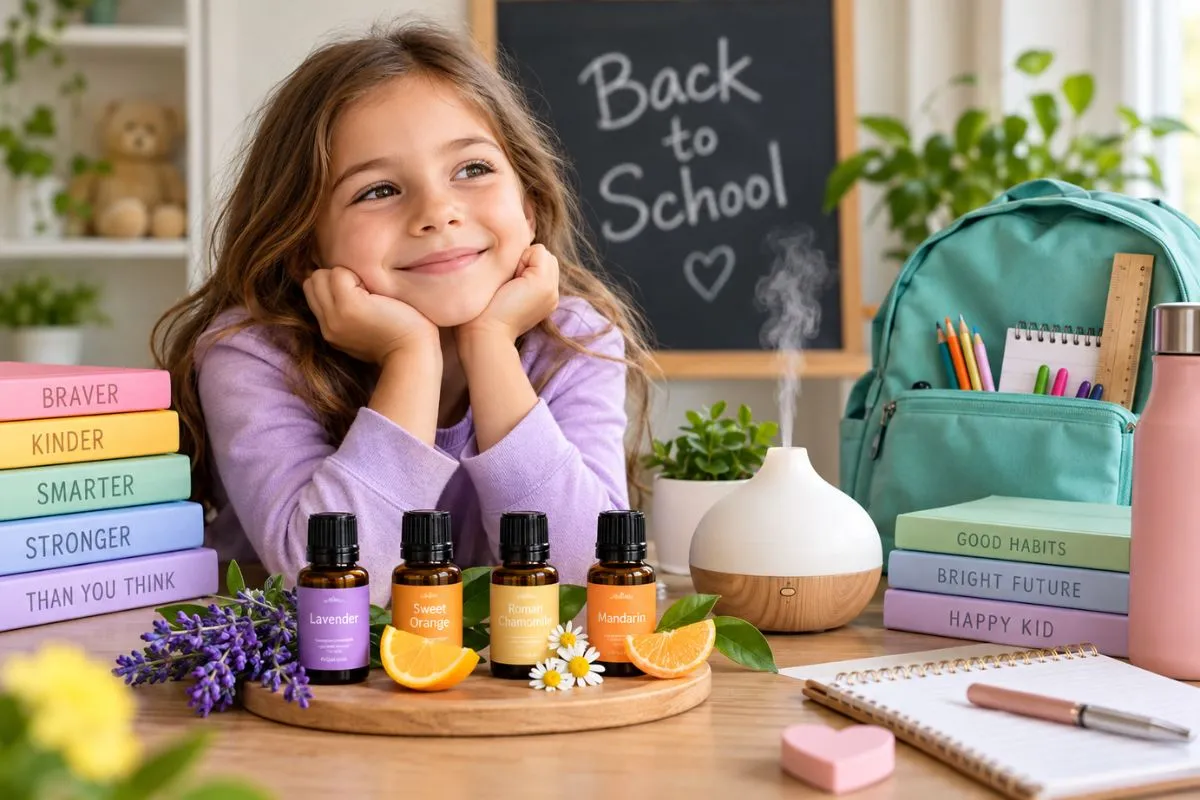
Can Calming Essential Oils for Kids Really Help?
Essential oils contain concentrated aromatic compounds extracted from plants. When their aromas are inhaled, scent receptors communicate with areas of the brain involved in emotions and memory. This is one reason familiar smells can feel comforting or energizing.
Research into aromatherapy is still developing. Some studies suggest certain aromas may support relaxation, mood, or perceived stress, while other studies find more limited effects. Johns Hopkins notes that research results on essential oils are mixed and advises against treating them as proven cures for medical conditions.
Therefore, discussions about essential oils for anxiety in children need careful wording.
Aromatherapy should not be presented as a treatment for an anxiety disorder. Instead, selected aromas may help create a calmer environment or become part of a soothing routine for children who enjoy them.
If school worries are persistent, interfere with sleep, cause frequent physical symptoms, trigger school refusal, or affect daily life, speaking with your child’s pediatrician or an appropriate mental-health professional is much more important than experimenting with essential oils.
7 Calming Essential Oils for Kids to Consider
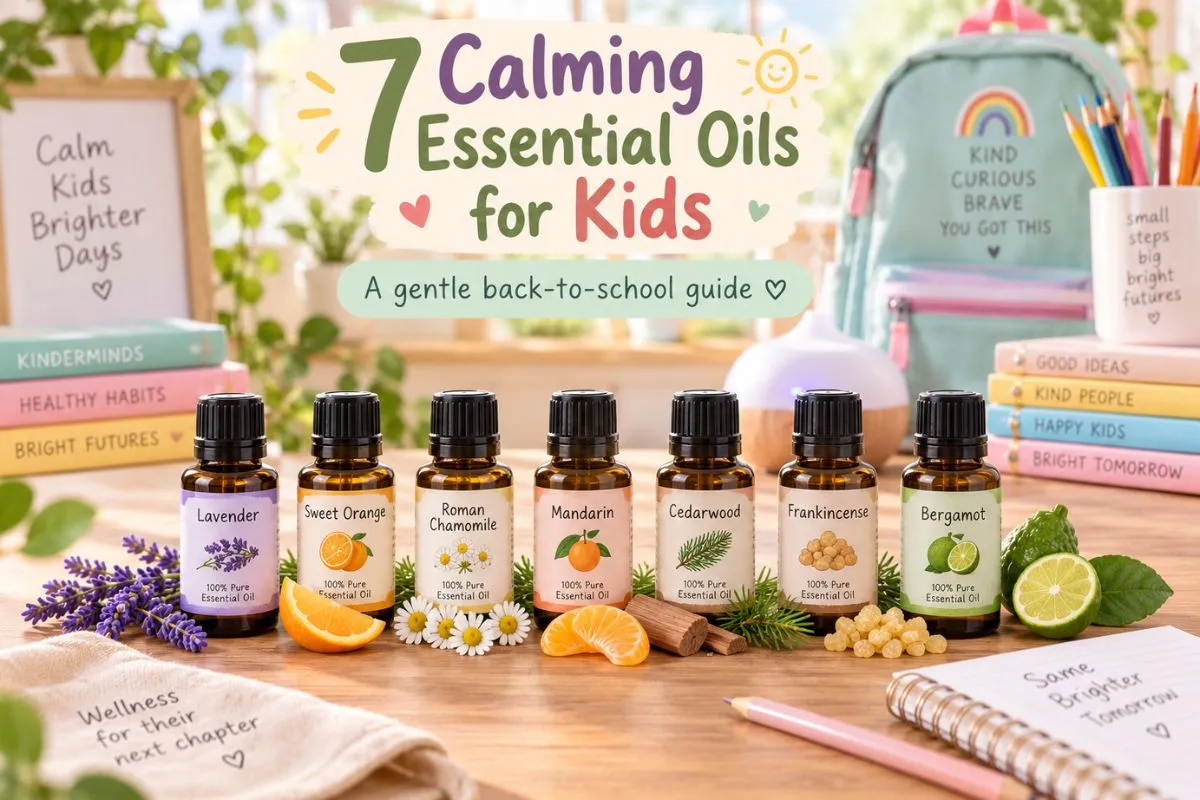
Not every essential oil is appropriate for every child. Age, allergies, asthma, medications, concentration, and the method of use all matter. The following oils are commonly associated with gentle aromatherapy routines, but parents should still check individual precautions before use.
1. Lavender Essential Oil
Lavender is probably the best-known calming aroma. Its soft floral scent is frequently used in relaxation and bedtime routines and may be particularly helpful when the goal is to create a peaceful atmosphere before sleep.
For a child who feels restless the night before school, a familiar lavender aroma during story time or another relaxing activity can help signal that the busy part of the day is over.
The American Academy of Pediatrics’ HealthyChildren resource describes lavender among essential oils associated with relaxation, reduced agitation, and a sense of calm.
Lavender can therefore be one of the more practical calming essential oils for kids, provided it is used appropriately.
2. Sweet Orange Essential Oil
Sweet orange has a bright, familiar citrus aroma that can make a morning routine feel fresher and more cheerful.
Unlike very heavy relaxing scents, sweet orange can work nicely when a child needs comfort without turning the morning into sleepy time. It may suit breakfast preparation, getting dressed, or another relaxed at-home ritual.
CHOP includes citrus oils such as sweet orange and mandarin among aromatherapy options that have been studied for use with children over age three.
Because citrus scents often feel light and approachable, sweet orange can also be useful when introducing aromatherapy to an older child who dislikes strong herbal fragrances.
3. Roman Chamomile Essential Oil
Chamomile is strongly associated with comforting nighttime rituals, from herbal tea for adults to softly scented personal-care products.
Roman chamomile essential oil has a sweet, herbaceous aroma that parents may consider for a quiet evening routine. It can pair naturally with low lighting, screen-free time, reading, or calm conversation about the following school day.
When people search for essential oils for anxiety in children, chamomile frequently appears in wellness content. Still, it is more accurate to describe its aroma as potentially relaxing rather than claiming that it treats childhood anxiety.
4. Mandarin Essential Oil
Mandarin offers another gentle citrus aroma and may work especially well in an after-school reset routine.
Children often come home carrying more than backpacks. Noise, social interaction, lessons, activities, and long hours of concentration can leave them overstimulated.
A quiet snack, comfortable clothes, ten minutes without screens, and a pleasant familiar scent can create a useful transition between school and home.
Mandarin is one of the citrus oils CHOP specifically mentions among options used in pediatric aromatherapy guidance for children older than three.
5. Cedarwood Essential Oil
Cedarwood has a warm, woody aroma that many people describe as grounding.
Rather than using it as a supposed “focus medicine,” think of cedarwood as part of an environment designed for slower, more deliberate activities such as reading, drawing, or preparing the school bag for tomorrow.
Some children love woody aromas while others simply do not. Personal preference matters enormously in aromatherapy. A scent that one child finds relaxing may bother another child, so never force an aroma because a wellness trend says it should work.
6. Frankincense Essential Oil
Frankincense has a deep, resinous scent frequently associated with reflective or peaceful environments.
For older children who enjoy the aroma, it may fit into a quiet evening ritual, mindfulness exercise, breathing practice, or family wind-down period.
If you are exploring essential oils for anxiety in children, remember that the calming routine around the scent may be just as important as the scent itself. Sitting together, listening without judgment, preparing tomorrow’s clothes, and reducing last-minute morning chaos can provide meaningful reassurance.
7. Bergamot Essential Oil
Bergamot combines citrus freshness with a more complex floral character. It is popular in adult relaxation blends, but topical use deserves extra caution because some bergamot preparations can increase sensitivity to sunlight.
For children, keeping aromatherapy simple is usually wiser than building complicated multi-oil formulas.
If bergamot is considered for topical use, parents should verify whether the product is phototoxic and follow professional dilution and sun-exposure guidance. This is another reason a safety-first approach is more valuable than simply collecting as many oils as possible.
How to Use Calming Essential Oils for Kids Safely
Essential oils are concentrated substances. “Natural” does not automatically mean risk-free.
Johns Hopkins states that children can be more susceptible than adults to adverse reactions and advises parents not to apply undiluted essential oils directly to children’s skin, allow children to swallow them, or use them near the eyes, ears, or nose. It also recommends appropriate dilution, patch testing, safe storage, and consultation with a healthcare professional when needed.
CHOP takes a cautious approach to pediatric aromatherapy and recommends limiting aromatherapy to children over age three because research in younger children is insufficient. It also warns against prolonged room diffusion, ingestion, and direct application of pure oils to children’s skin.
This matters enormously when reading online recipes for essential oils for anxiety in children. A recipe created for an adult should never automatically be used on a child.
If topical use is being considered, dilute the oil appropriately in a suitable carrier product and follow guidance for the child’s age and the specific oil. Johns Hopkins notes that pediatric dilution ranges depend on age, weight, and circumstances.
Children with asthma, allergies, sensitive skin, chronic health conditions, or prescription medications deserve additional caution. CHOP advises consulting a healthcare provider because certain essential oils can worsen some conditions or interact with medications.
And perhaps the simplest safety rule: if your child says a scent makes them uncomfortable, stop using it.
A Calmer Back-to-School Morning Routine
A peaceful school morning begins long before the alarm rings.
Prepare uniforms or clothes, backpacks, permission slips, lunch items, and breakfast basics the night before. When fewer decisions are waiting at 7 a.m., everyone has more emotional space.
Then create a familiar sequence: wake up, wash, dress, eat, pack, and leave.
If your child enjoys aromatherapy, calming essential oils for kids can become one optional cue within that routine. The scent should never become something the child “needs” in order to function; it is simply an enjoyable environmental signal associated with a predictable morning.
Try pairing the routine with other grounding habits: opening curtains for morning light, playing gentle music, offering water, taking a few slow breaths together, or giving your child a simple reminder such as, “You know what to do, and we will see each other after school.”
Small routines can feel surprisingly powerful when everything else seems new.
What About Essential Oils for Anxiety in Children?
Parents naturally want relief when they see a child worrying.
However, essential oils for anxiety in children should never be framed as a substitute for proper assessment or support.
Temporary back-to-school nerves are different from persistent anxiety. A child who worries for several days before school but settles once routines become familiar may simply be adapting. A child experiencing ongoing distress, panic, repeated stomachaches, sleep disruption, significant avoidance, or refusal to attend school may need professional support.
Aromatherapy can sit alongside evidence-based habits such as predictable routines, sufficient sleep, physical activity, reassurance, open communication, breathing exercises, and appropriate professional care.
The goal is not to erase every uncomfortable feeling. It is to help children learn that they can experience uncertainty and still move through it safely.
Create an After-School Reset
The moment children return home can tell parents a lot. Some kids immediately talk about every detail of the day. Others become quiet, irritable, hungry, emotional, or exhausted.
Instead of firing ten questions the second they walk through the door, give them a little room to land. Offer water and a snack. Let them change clothes. Give them a few minutes of quiet play or rest. Once their nervous system has shifted away from the stimulation of school, conversation often becomes easier.
If they enjoy scent, this can be another appropriate moment for calming essential oils for kids to become part of the atmosphere at home.
Make Homework Time Feel Less Overwhelming
Aromatherapy cannot complete multiplication tables or write tomorrow’s book report. But the environment around homework matters.
Create a defined workspace with good lighting, limited clutter, water nearby, and as few distractions as reasonably possible. Break long assignments into manageable pieces and allow age-appropriate movement breaks.
Parents sometimes search for essential oils for anxiety in children because homework triggers frustration or worry. Before reaching for an oil, look at the source of the stress. Is the assignment too difficult? Is the child overtired? Hungry? Afraid of making mistakes? Struggling to understand instructions?
Addressing the actual problem comes first. If the child simply enjoys a familiar aroma while studying, it can remain a small part of the routine rather than the centerpiece.
A Gentle School-Night Wind-Down
Sleep and routine matter enormously during the school year.
Choose a reasonably consistent bedtime and gradually reduce stimulation as the evening progresses. Dim bright lights, finish highly energetic activities earlier, and try to create some screen-free time before bed.
Reading together, talking about one good part of the day, preparing tomorrow’s clothes, or practicing slow breathing can become powerful family rituals.
This is one of the most natural places to use calming essential oils for kids if your child likes them and they can be used safely.
Final Thoughts: A Calmer School Year Starts With Simple Choices
Back-to-school season does not have to be perfectly peaceful to be positive. A little nervousness, a forgotten lunchbox, a difficult homework night, or an emotional first week can all be part of adjusting.
What matters is creating an environment where children feel safe enough to talk, supported enough to try again, and confident that home remains a steady place at the end of a demanding day.
Used responsibly, aromatherapy can be one small part of that environment. Choose age-appropriate products, use conservative methods, and respect your child’s preferences.
At Hudira, we believe self-care should feel thoughtful, gentle, and connected to nature—not complicated. Explore Hudira organic products and discover beautifully considered options designed to bring a more mindful touch to your everyday self-care rituals.
FAQs:
Q. What are the best calming essential oils for kids?
Lavender, sweet orange, mandarin, and other gently aromatic oils are commonly considered in child-friendly aromatherapy routines. However, the safest choice depends on the child’s age, health, sensitivities, medications, and method of use. Always check precautions for the individual oil before using it with a child.
Q. Can essential oils for anxiety in children replace professional treatment?
No. Essential oils for anxiety in children should be viewed only as an optional complementary wellness practice. They cannot diagnose or treat an anxiety disorder. If anxiety is persistent, severe, or interfering with school, sleep, relationships, or daily life, consult your child’s healthcare professional.
Q. Is it safe to use essential oils in the classroom?
Essential oils in the classroom require extra caution because fragrances affect people differently. Other students may have asthma, allergies, migraines, sensory sensitivities, or other conditions. Parents should always check school policies and speak with the teacher or school nurse before sending scented products to school.
Q. Can I apply essential oils directly to my child’s skin?
Pure essential oils should not be applied undiluted to a child’s skin. Pediatric guidance recommends appropriate dilution and individual safety precautions. A patch test may also be appropriate before wider topical use. When uncertain, ask a pediatrician or qualified healthcare professional.
Q. At what age can children use aromatherapy?
Recommendations differ depending on the oil and method of use. CHOP takes a conservative approach and advises limiting aromatherapy to children over age three because evidence in younger children is insufficient. Individual oils can have additional age restrictions, so always check guidance for the specific product being considered.


Add comment