
No products in the cart.
Organic skincare sounds beautifully simple: botanical oils, plant extracts, floral waters, and skin-loving ingredients chosen with care. Yet the moment water enters a formula, another priority becomes just as important microbial safety. That is where natural preservatives for skin care matter. They help protect creams, lotions, gels, and cleansers from unwanted bacteria, yeast, and mold while supporting the freshness, stability, and integrity of a thoughtfully formulated product.
But here is the part many skincare lovers never hear: not every “natural” ingredient that protects a formula is actually a preservative. Vitamin E, rosemary extract, or a trendy plant ferment cannot automatically replace a complete preservation system. So, which natural preservatives for cosmetics genuinely work, which ingredients mainly support preservation, and what should you look for on a skincare label? The answers may completely change how you view organic beauty.
Why Does Organic Skincare Still Need Preservatives?
The word organic can create the impression that a skincare product should remain completely untouched by preservatives. In reality, organic ingredients are not magically protected from microorganisms.
Water-containing skincare products can provide an environment in which bacteria, yeast, and mold may grow if the formula is not adequately protected. Each time you open a jar, touch a cream, use a pump, or store a product in a warm and humid bathroom, it meets the real world.
That is why natural preservatives for skincare should not automatically be considered something negative. When properly selected and used, preservation is part of responsible skincare formulation.
The goal is not to make a product last forever. Instead, preservation helps a product remain safe, stable, and suitable for use throughout its intended shelf life.
Most importantly, natural cosmetic preservatives should never be selected simply because an ingredient has a botanical-sounding name. Professional formulators consider factors such as:
- Water content
- Product pH
- Ingredient compatibility
- Packaging
- Manufacturing hygiene
- Expected shelf life
- Storage conditions
- Microbial risk
- Preservation efficacy testing
So, instead of asking, “Does this organic skincare contain preservatives?” a smarter question is:
“Is this formula appropriately preserved for the type of product it is?”
That small shift makes a huge difference.
What Are Natural Preservatives for Skin Care?
Natural preservatives for skin care are ingredients or preservation systems that help reduce or prevent unwanted microbial growth while fitting into a natural, naturally derived, or organic cosmetic formulation philosophy.
However, the word natural can be surprisingly complicated.
Natural ingredients
These are obtained from naturally occurring sources such as plants, minerals, or fermentation processes, although processing may still be necessary before they can be used safely and consistently in cosmetics.
Naturally derived ingredients
These begin with naturally sourced raw materials but undergo processing to create ingredients with the stability, purity, or functionality required in modern cosmetics.
Nature-identical ingredients
These are manufactured ingredients chemically equivalent or very similar to compounds found in nature.
That is why evaluating natural preservatives for cosmetics requires more than reading marketing claims on the front of a package. Their effectiveness, permitted concentration, compatibility, safety profile, and suitability for a specific formula matter far more than whether their name sounds “green.”
Likewise, the term natural cosmetic preservatives can refer to several categories, including organic acids, fermentation-derived ingredients, preservative blends, and multifunctional ingredients that support a broader preservation strategy.
Natural Preservatives for Cosmetics: What Makes Them Effective?
There is no magical preservative that works perfectly in every lotion, serum, cleanser, or mask.
A preservation system that performs beautifully in one face cream may perform poorly in another because the formulations are different. When professional formulators select natural preservatives for cosmetics, they normally evaluate several important factors.
1. Antimicrobial Coverage
Preservation must consider different types of microorganisms, particularly bacteria, yeast, and mold. Some ingredients are better at controlling fungi, while others provide stronger antibacterial action. Therefore, formulators frequently combine ingredients to achieve broader protection.
2. The Product’s pH
Many organic acids and their salts work more effectively within certain acidic pH ranges.
A preservative that performs well at one pH may become considerably less effective if the formula moves outside its preferred range. Therefore, pH is not simply about how a product feels on your skin. It can directly influence preservation.
3. Water Content
Water changes everything. A dry facial mask, powder cleanser, or facial oil presents a very different microbial environment from a lotion containing a significant amount of water.
This is one reason water-based skincare usually requires greater attention to microbial preservation.
4. Packaging
Packaging can support a well-designed preservation strategy. For example, an airless pump or narrow dispenser may reduce repeated direct contact with the formula compared with a wide-open jar.
However, packaging should support preservation—not replace it.
5. The Complete Formula
Botanical extracts, proteins, surfactants, clays, emulsifiers, oils, and active ingredients can all affect preservative performance.
Preservation must therefore be evaluated inside the finished product rather than judging an ingredient in isolation.
6. Testing
This is incredibly important. Natural preservatives for skincare should not be assumed to work simply because an ingredient has antimicrobial properties or because another brand successfully uses it.
Commercial cosmetic formulations should undergo appropriate stability and microbiological assessment. Where relevant, preservative efficacy or challenge testing is used to determine whether the complete preservation system can adequately control microbial contamination.
In skincare formulation, evidence beats assumptions every time.
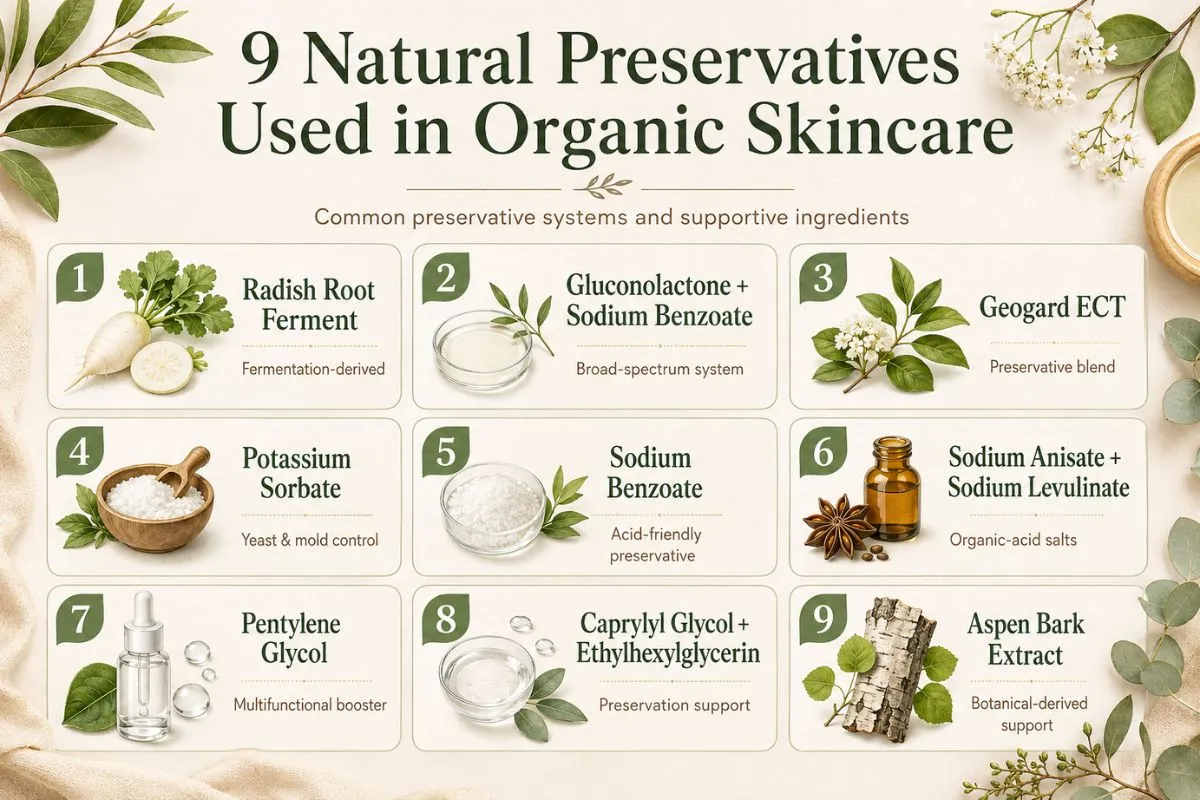
9 Natural Preservatives and Preservation Ingredients Used in Organic Skincare
Now for the exciting part.
Several ingredients and preservative systems have become popular in natural and organic cosmetic formulation. However, some are primary preservatives while others are multifunctional ingredients or preservation boosters.
Understanding that difference is essential.
1. Leuconostoc/Radish Root Ferment Filtrate
Radish root ferment has become one of the most recognizable ingredients associated with naturally positioned skincare.
It is produced through fermentation involving Leuconostoc bacteria and is valued for its antimicrobial activity.
You may see Leuconostoc/Radish Root Ferment Filtrate in creams, serums, toners, gels, and other botanical formulas.
Its fermentation origin also makes it attractive to brands looking for alternatives that align with naturally inspired product development.
However, although radish root ferment can contribute valuable antimicrobial activity, it should not automatically be considered the best natural preservative for every product.
Depending on the formula and supplier system, additional preservation support may be necessary.
Among natural cosmetic preservatives, radish root ferment is especially attractive because consumers can easily connect its fermentation origin with modern botanical skincare. Still, performance and testing should always come before marketing appeal.
2. Gluconolactone and Sodium Benzoate
Gluconolactone combined with sodium benzoate is one of the better-known preservation systems used in naturally positioned cosmetics.
Gluconolactone is a polyhydroxy acid that can also act as a humectant, while sodium benzoate provides antimicrobial preservation, particularly when used under appropriate acidic conditions.
Together, the ingredients can form a useful broad preservation system for products such as:
This combination has become popular among formulators looking for natural preservatives for skincare because it can fit into many natural-formulation approaches while providing practical functionality.
However, as with all natural preservatives for cosmetics, performance depends on the finished product’s pH, concentration, processing, packaging, and complete ingredient system.
3. Benzyl Alcohol, Salicylic Acid, Glycerin and Sorbic Acid
This combination is used in ready-made preservation systems commonly found in natural cosmetic formulation.
Depending on the supplier and market, you may recognize blends containing these ingredients under trade names such as Geogard ECT or Preservative Eco.
The individual ingredients provide complementary functions that allow the system to offer broad antimicrobial protection across suitable cosmetic applications.
It can be used in products including:
- Face creams
- Body lotions
- Cleansers
- Emulsions
- Selected serums
This preservation blend perfectly demonstrates something important about natural cosmetic preservatives:
Effective preservation is often about teamwork.
Instead of expecting one trendy ingredient to fight every microbial challenge, formulators can combine several complementary components to create stronger protection.
4. Potassium Sorbate
Potassium sorbate is widely used in both food and cosmetic applications.
It is particularly useful against yeast and mold and generally performs better in acidic environments.
Because its antibacterial protection is more limited, potassium sorbate is often combined with other preservation ingredients instead of being used as the sole broad-spectrum solution.
For anyone researching natural preservatives for beauty products, potassium sorbate is a useful ingredient name to recognize.
Seeing potassium sorbate on an ingredient list does not automatically make a cosmetic “less natural.” It may simply be one component of a carefully designed preservation system intended to help keep a water-containing formula stable and protected.
5. Sodium Benzoate
Sodium benzoate is another familiar preservative used in food, personal care, and cosmetic formulations.
Like potassium sorbate, its effectiveness is strongly influenced by pH. It performs particularly well in appropriately acidic environments and is frequently combined with other ingredients to create broader antimicrobial protection.
This highlights an important truth about natural preservatives for skin care:
A single ingredient does not necessarily tell you everything about the preservation system.
One ingredient may primarily help control certain microorganisms while another strengthens protection against others. Evaluating the complete formula gives you a much clearer picture than judging one unfamiliar ingredient name.
6. Sodium Anisate and Sodium Levulinate
Sodium anisate and sodium levulinate are salts of organic acids used in various natural and naturally derived cosmetic formulations. They can contribute antimicrobial properties and often appear as part of preservation systems designed for botanical products.
These ingredients are particularly interesting because they reflect a broader move toward multifunctional formulation. Modern formulators increasingly select ingredients that may contribute more than one benefit to a product, such as supporting preservation while also influencing formula stability or skin feel.
However, when discussing natural preservatives for skincare, it is important not to claim that these ingredients will adequately preserve every formulation by themselves. Their performance depends on factors including:
- Concentration
- Formula pH
- Water activity
- Ingredient compatibility
- Manufacturing process
- Other preservation components
The final formulation still needs appropriate assessment.
7. Pentylene Glycol
Pentylene glycol deserves special attention because it is frequently misunderstood. It is primarily a multifunctional ingredient and humectant, helping a formula attract and retain moisture. Certain grades can also be naturally derived.
Interestingly, pentylene glycol can provide antimicrobial support and may enhance the performance of a wider preservation system.
However, it is not always categorized as a primary preservative. It is often better understood as a preservative booster or multifunctional ingredient.
This makes pentylene glycol incredibly useful when explaining natural cosmetic preservatives, because good preservation is not always achieved through one “hero” ingredient. Instead, formulators may create several complementary barriers or hurdles that make the product less hospitable to unwanted microorganisms.
8. Caprylyl Glycol and Ethylhexylglycerin
Caprylyl glycol and ethylhexylglycerin are multifunctional ingredients commonly used to help strengthen preservation systems. They can contribute antimicrobial support while also providing useful cosmetic properties, including moisturizing or sensory benefits.
Their source and acceptance under specific natural or organic certification standards can vary, so brands should be careful about casually describing every version as completely natural. Nevertheless, these multifunctional ingredients are important when discussing modern natural preservatives for cosmetics.
A sophisticated skincare formula may contain a primary preservative alongside boosters that improve overall microbial protection. That combination can sometimes be more effective than relying heavily on a single preservation ingredient.
9. Aspen Bark Extract
Aspen bark extract is another botanical ingredient occasionally promoted for its antimicrobial properties. Aspen bark naturally contains salicylate-related compounds and may provide useful preservation support in certain cosmetic formulas.
At first glance, it sounds like an ideal natural cosmetic preservative. But this is precisely where careful formulation science becomes important.
A botanical extract that demonstrates antimicrobial activity should not automatically be assumed to provide complete protection against bacteria, yeast, and mold in every water-based cosmetic.
Natural origin is appealing. Reliable performance is essential. The two should work together rather than compete.
Natural Preservatives for Skin Care vs Preservative Boosters
One of the most confusing areas in organic beauty is the difference between a preservative and a preservative booster.
A primary preservative is selected specifically to help prevent or control unwanted microbial growth in the finished cosmetic. A preservative booster, meanwhile, helps strengthen the overall preservation system. Ingredients such as pentylene glycol, caprylyl glycol, and ethylhexylglycerin may provide useful antimicrobial support depending on how they are formulated.
Think of it like protecting a home. The primary preservative is the security system. Preservative boosters are the stronger locks, better lighting, and additional barriers that make the overall system more effective.
Most importantly:
“Contains antimicrobial ingredients” does not automatically mean “adequately preserved.”
That is why natural preservatives for skin care should be understood as part of a complete formulation strategy involving pH, ingredient compatibility, manufacturing hygiene, packaging, storage, and testing.
Natural Preservatives for Skincare vs Antioxidants: Know the Difference
This distinction is huge. A preservative helps control microorganisms such as bacteria, yeast, and mold. An antioxidant helps slow oxidation.
Oxidation can cause oils to become rancid, create unpleasant odors, change color, or gradually damage sensitive ingredients. But preventing oxidation is not the same thing as controlling microbial growth.
Vitamin E
Vitamin E or tocopherol is one of the most common examples. It can be extremely useful in oil-based skincare because it helps slow oxidative deterioration. However, vitamin E is not a broad-spectrum antimicrobial preservative for a water-based cream.
Rosemary Antioxidant Extract
Rosemary antioxidant extracts can also help protect oils against oxidation. Again, that does not automatically place them in the same category as natural preservatives for cosmetics that control bacteria, yeast, and mold.
So if your face oil contains vitamin E, wonderful, it may be providing antioxidant protection. But if a water-based lotion contains vitamin E, do not automatically assume vitamin E is what keeps that lotion microbiologically safe.
Understanding this difference makes reading skincare labels so much easier.
Do Waterless Products Need Natural Preservatives for Skincare?
Not every skincare product presents the same microbial risk. Dry powders, facial oils, cleansing oils, and truly anhydrous balms contain little or no available water compared with lotions, creams, toners, or water-based gels.
Because microorganisms generally need available water to grow, genuinely waterless products can have a very different preservation requirement. But there is an important catch.
Waterless does not mean invincible.
A dry product may eventually encounter moisture through:
- Wet fingers
- Damp applicators
- Bathroom humidity
- Steam
- Improper storage
- Contaminated utensils
This is particularly relevant for powder masks that consumers mix with water immediately before use.
For dry Hudira-style products, good habits can help protect product quality:
- Keep the powder dry.
- Use a clean, dry spoon or applicator.
- Avoid putting wet fingers into the container.
- Securely close the packaging after use.
- Mix only the quantity you need.
- Follow the brand’s storage and use instructions.
This is an excellent example of why preservation decisions should always depend on the actual product, rather than a blanket rule.
Are Natural Preservatives Better Than Synthetic Preservatives?
Not automatically and this is where clean beauty deserves a more thoughtful conversation.
The word natural describes sourcing or formulation philosophy. It does not guarantee that an ingredient is automatically safer, gentler, or more effective. Likewise, synthetic does not automatically mean dangerous, harsh, or undesirable.
The better questions are:
Is the ingredient safe at its intended concentration?
Does it work in this formulation?
Is the finished product appropriately protected?
Brands may select natural preservatives for cosmetics because they want to meet particular natural or organic formulation standards, support a botanical brand philosophy, or respond to consumer preferences.
Those are completely valid reasons. But preservation still has to work. The strongest clean-beauty message is not:
Synthetic = bad. Natural = good.
It is:
Thoughtfully formulated. Transparently labeled. Appropriately preserved.
That message is more positive, responsible, and reassuring.
How to Find Natural Cosmetic Preservatives on an Ingredient Label
Skincare labels become far less mysterious once you know what you are looking for. Instead of judging an ingredient because its scientific name looks unfamiliar, learn what that ingredient actually does.
Common preservation-related names may include:
- Leuconostoc/Radish Root Ferment Filtrate
- Sodium Benzoate
- Potassium Sorbate
- Gluconolactone
- Benzyl Alcohol
- Sorbic Acid
- Sodium Levulinate
- Sodium Anisate
- Pentylene Glycol
- Caprylyl Glycol
- Ethylhexylglycerin
Next, consider the type of product. A water-rich lotion will normally require a more obvious antimicrobial protection strategy than a completely dry powder mask. An oil-based serum may place greater emphasis on antioxidants because oxidation of oils is an important stability concern.
Also, be cautious when you see a water-rich cream proudly marketed as “preservative-free.” That claim should not automatically impress you. Instead, it should make you curious about how the product’s microbiological safety, packaging, manufacturing, storage, and shelf life have been addressed.
How Brands Choose Natural Preservatives for Cosmetics
Professional cosmetic formulation is a balancing act.
The preservative has to perform within the product’s pH range. It must remain compatible with emulsifiers, surfactants, botanical extracts, oils, proteins, clays, and active ingredients. It must also continue working throughout the intended shelf life. That is why asking for the single best natural preservative can be misleading.
There is no universal winner. Instead, formulators may use what is sometimes called a hurdle approach, combining multiple protective factors such as:
- An appropriate preservative system
- Controlled product pH
- Reduced water activity where suitable
- Multifunctional antimicrobial boosters
- Chelating ingredients where appropriate
- Hygienic manufacturing
- Protective packaging
- Suitable storage conditions
The ideal preservation strategy is the one proven suitable for the specific finished formula. That is far more reliable than picking a preservative from a “top ten” list and hoping for the best.
5 Common Myths About Natural Preservatives for Skincare
Myth 1: Organic skincare should never contain preservatives
Reality: Water-containing skincare can require antimicrobial preservation. Including an appropriate preservative can be an important part of responsible formulation.
Myth 2: Vitamin E is a natural preservative
Reality: Vitamin E is primarily an antioxidant. It helps protect oils from oxidation but does not provide complete antimicrobial protection for a water-based cosmetic.
Myth 3: Essential oils can preserve a cream
Reality: Some essential oils show antimicrobial properties, but that does not automatically make them suitable replacements for a validated broad-spectrum cosmetic preservation system.
Myth 4: Natural always means gentle
Reality: Natural ingredients can still cause irritation or allergic reactions in some people. Safety depends on the ingredient, concentration, complete formula, and individual skin response.
Myth 5: Protective packaging means preservatives are unnecessary
Reality: Smart packaging may reduce contamination exposure, but it does not automatically replace appropriate preservation.
A Smarter Way to Choose Organic Skincare
The next time you shop for organic or botanical skincare, look beyond the big words printed on the front of the packaging. Ask a few simple questions:
Is the product water-based or waterless?
Does the brand provide a transparent ingredient list?
Does the packaging make sense for the formula?
Are storage instructions provided?
Does the brand explain unfamiliar ingredients rather than simply labeling everything “chemical-free”?
Most importantly, do not become afraid of a skincare product just because you recognize a preservative on its ingredient list. Natural preservatives for skincare are used because a beautiful formula still needs to survive life outside the laboratory.
It will be transported.
Opened.
Closed.
Touched.
Stored.
Used repeatedly.
Preservation does not automatically make organic skincare less pure or less desirable. Thoughtful preservation can instead help protect the product you paid for and the skincare ritual you enjoy.
That is a far more empowering way to understand modern organic beauty.
Discover Hudira Organic Products for a More Mindful Skincare Ritual
At Hudira, botanical skincare is about more than attractive labels or trendy ingredients. It is about celebrating plant-inspired ingredients, mindful routines, and uncomplicated self-care while respecting the science behind effective skincare.
Whether you love botanical powders, masks, or naturally inspired skin rituals, knowing how products are formulated helps you make more confident choices.
Your skincare deserves transparency not confusing fear-based marketing.
Explore Hudira organic products today and discover a botanical skincare ritual designed to make self-care feel simple, thoughtful, comforting, and beautifully yours.
FAQs:
Q. What are natural preservatives?
They are ingredients or systems that help control bacteria, yeast, and mold in natural or organic cosmetic formulations. They are often derived from fermentation, organic acids, or blended preservation systems.
Q. How to preserve natural skin care products safely?
Safety depends on more than just preservatives. Water content, pH, hygiene, packaging, storage, and testing all matter. Water-based products should be professionally formulated and tested.
Q. Is vitamin E one of the natural preservatives for cosmetics?
No. Vitamin E is an antioxidant, not a true preservative. It helps prevent oil oxidation but does not protect water-based products from microbial growth.
Q. Do water-free skincare products need preservatives?
Water-free products have lower microbial risk, but they are not risk-free. Contamination can still occur during use, so proper packaging, handling, and storage are still important.
Q. Are natural preservatives for beauty products better for sensitive skin?
Not always. Natural preservatives can still cause irritation, and synthetic ones can be gentle. What matters most is the full formulation and how your skin reacts, not whether it is labeled “natural.”

Add comment