
No products in the cart.
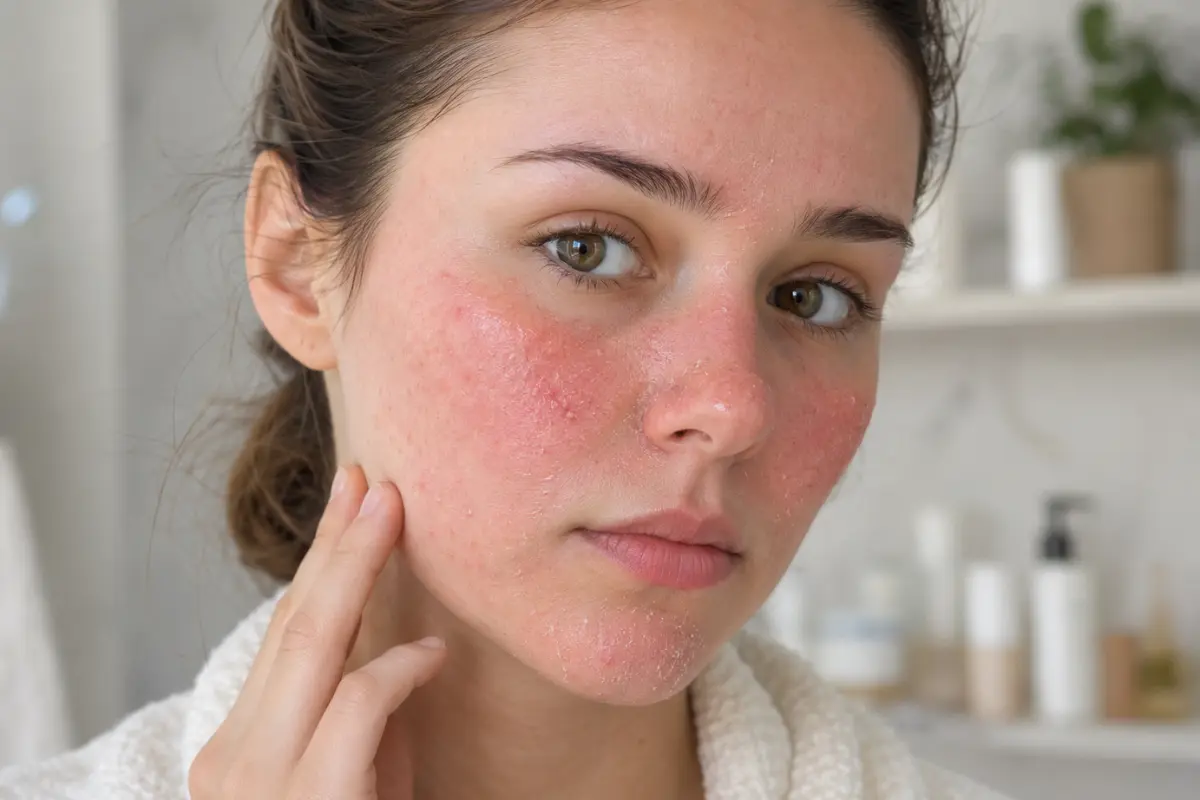
One extra scrub, one strong acid, or one too-many “glow-boosting” treatments can turn smooth skin into a red, tight, bumpy mess surprisingly fast. Over-exfoliation happens when exfoliating too often or too aggressively disrupts the skin’s protective barrier, leaving it more vulnerable to dryness, irritation, burning, and sensitivity. If your once-comfortable routine suddenly stings or you notice over exfoliation bumps—your skin may be asking for recovery, not another active ingredient.
But here’s where things get interesting: adding more products is not always the answer. Some “natural” fixes may actually irritate already-sensitive skin, while a few surprisingly simple steps can make recovery far easier. So, what should you stop immediately, which gentle remedies are worth trying, and how can you tell when over-exfoliated skin is finally ready for your normal routine again?
What Is Over Exfoliation?
Exfoliation removes dead cells from the outer surface of the skin. It can be done physically with scrubs, brushes, or textured tools, or chemically with ingredients such as glycolic acid, salicylic acid, and other exfoliating acids.
When done appropriately for your skin type, exfoliation can be part of a healthy skincare routine. However, over exfoliation occurs when the frequency, strength, or combination of exfoliating products becomes more than your skin can comfortably tolerate.
The American Academy of Dermatology warns that excessive exfoliation can cause redness and irritation and that overusing an exfoliator may damage the skin barrier.
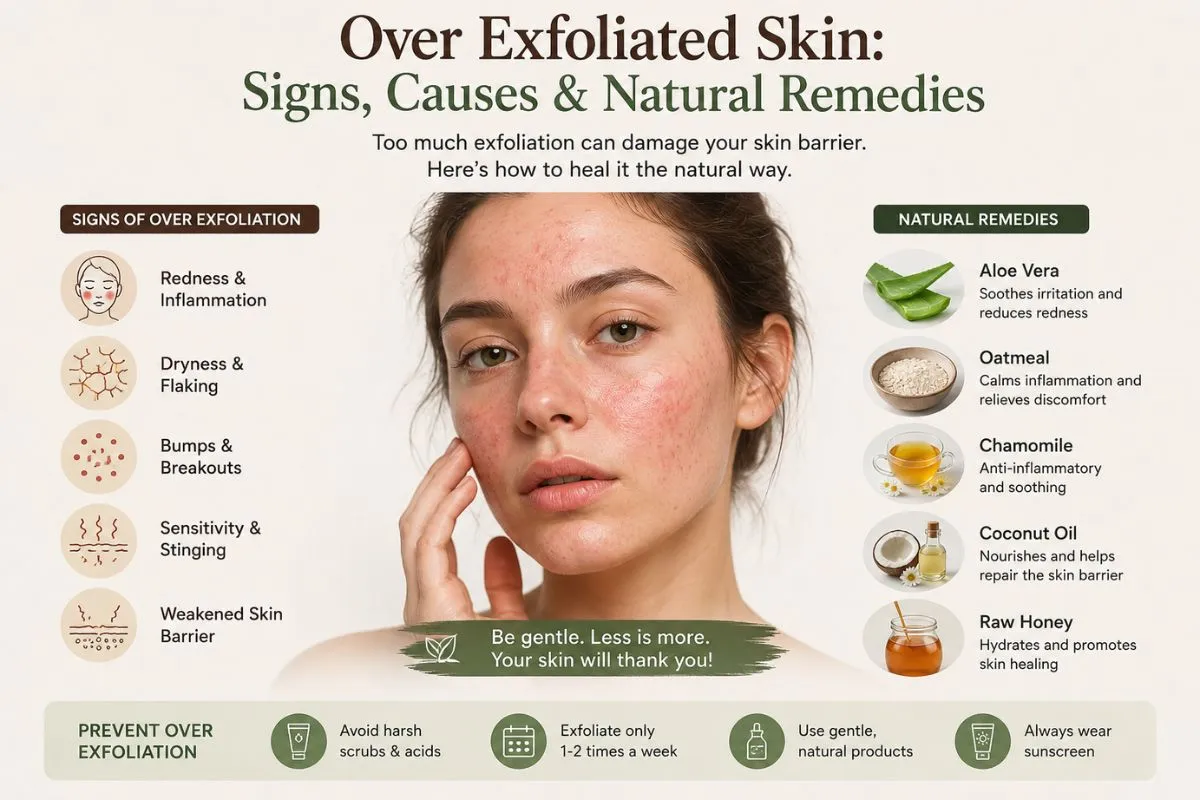
Once that barrier becomes irritated, over exfoliated skin may:
- Feel unusually tight
- Burn or sting when products are applied
- Become dry or flaky
- Look red or inflamed
- Feel more sensitive than usual
- Develop small over exfoliation bumps
- React to products that were previously comfortable
In other words, the glow you were chasing can suddenly become the exact opposite.
What Happens If You Exfoliate Too Much?
If you’ve ever wondered what happens if you exfoliate too much, the answer begins with your skin barrier.
The outermost part of the epidermis, especially the stratum corneum, plays an essential role in limiting water loss and protecting the body from the external environment. When that barrier is disrupted, water can escape more easily and irritants may affect the skin more readily. Transepidermal water loss, or TEWL, is one measure researchers use to evaluate skin-barrier integrity.
That is why over-exfoliation may make your face feel dry and oily at the same time, painfully tight, unusually shiny, or suddenly reactive.
You may also notice over exfoliation bumps, especially if irritation is accompanied by inflammation or if multiple strong products have been layered together.
However, bumps are not automatically proof of over-exfoliation. Acne, folliculitis, allergic reactions, rosacea, and other skin conditions can look similar. Persistent, painful, spreading, blistering, or severe symptoms deserve professional medical assessment rather than more experimentation at home.
Why Do Over Exfoliation Bumps Appear?
Seeing new texture after trying to “smooth” your skin is frustrating. Yet over exfoliation bumps can be a sign that your routine has become too aggressive.
Some people experience tiny rough bumps, redness, sensitivity, or acne-like breakouts when their skin barrier becomes irritated. Masks and exfoliating products that are used too often or contain unsuitable ingredients can contribute to irritation, dryness, and breakouts.
You may describe them as red bumps after exfoliating, especially when the skin also feels warm, itchy, or tender.
Others notice bumps after exfoliating without much redness.
The most important thing is not to immediately attack those bumps with another acid, scrub, peel, or drying treatment. If the bumps are connected to irritation, doubling down on exfoliation can make the cycle worse.
Instead, treat over exfoliation bumps as a sign to simplify first.
How to Recognize Over-Exfoliation Before It Gets Worse
Your skin does not always scream immediately. Sometimes it whispers first.
Look for these early warning signs of over-exfoliation:
1. Your usual moisturizer suddenly stings
Products that normally feel comfortable may start burning when your barrier is irritated. The AAD notes that damaged skin can become reactive even to products that previously caused no trouble.
2. Your face feels tight after cleansing
That squeaky-clean sensation is not necessarily a victory. If cleansing leaves your skin tight, dry, or uncomfortable, your routine may be removing more oil than your skin can comfortably lose.
3. You notice unusual shine
Sometimes over exfoliated skin appears smooth or shiny while still feeling dehydrated and uncomfortable. Do not assume that a shiny surface means your barrier is healthy.
4. Flaking suddenly increases
Dry patches, peeling, or flakes after several exfoliating sessions are a clear reason to reduce irritation.
5. Small bumps appear
Over exfoliation bumps can accompany redness, dryness, sensitivity, or burning. If you also notice over exfoliated skin bumps, resist the urge to scrub them away.
6. Your skin feels more sensitive to heat or products
A routine that suddenly feels “too strong” deserves attention.
7 Gentle Natural Remedies for Over-Exfoliated Skin
When over exfoliation has already happened, the goal changes.
You are no longer trying to remove more dead skin. You are trying to create a calm environment in which the skin can recover.
Here are seven gentle approaches.
1. Stop Exfoliating Temporarily
This is the most important step.
Pause:
- Facial scrubs
- Exfoliating brushes
- Peeling pads
- Glycolic acid
- Salicylic acid
- Strong exfoliating masks
- At-home peels
- Other exfoliating acids
The AAD specifically advises against over-exfoliating because it can leave skin red and irritated.
If you’re experiencing over exfoliation bumps, scrubbing them harder is unlikely to be the gentle solution your barrier needs.
Give over exfoliated skin a break.
2. Switch to Gentle, Lukewarm Cleansing
Hot water and harsh cleansers can feel brutal on sensitized skin.
Use lukewarm water and a mild cleanser that does not leave your face feeling stripped. For dry and sensitive skin, dermatologists commonly recommend gentle, fragrance-free products because fragrances can contribute to irritation.
Wash with your fingertips rather than:
- Scrubbing cloths
- Rough sponges
- Facial brushes
- Grainy cleansing powders
The vibe should be less friction, less drama.
When over-exfoliation is active, gentle cleansing is enough.
3. Try Colloidal Oatmeal
Colloidal oatmeal is one of the more evidence-supported soothing ingredients often used in products formulated for dry and irritated skin.
Clinical research has found oatmeal-containing skin products can support moisturization and skin-barrier function in certain dry-skin conditions.
Rather than making an abrasive oatmeal scrub, choose a properly formulated colloidal oatmeal product. That distinction matters.
You want oatmeal’s soothing properties not rough particles physically rubbing over exfoliated skin.
4. Use a Cool Compress for Temporary Comfort
If your face feels hot or uncomfortable, a clean, cool compress may provide temporary soothing.
Use cool, not freezing water. Do not rub the skin. Simply hold a soft, clean cloth gently against the affected area for several minutes.
This won’t magically “repair” the barrier overnight, but it may make irritated skin feel more comfortable while you remove the triggers causing over exfoliation.
5. Moisturize Consistently
Moisturizer may not sound like an exciting “remedy,” but simple barrier support often beats complicated DIY recipes.
Moisturizers help add and retain moisture, while emollients soften and smooth dry skin. Evidence from dermatologic research supports regular moisturizer use for improving barrier function in dry or barrier-impaired skin conditions.
Look for simple formulas that your skin tolerates.
Useful moisturizing ingredients may include:
- Glycerin
- Ceramides
- Squalane
- Petrolatum
- Hyaluronic acid
- Other gentle emollients and humectants
Ceramide-containing formulations have also shown benefits for dry skin and barrier function in clinical research, particularly in conditions involving impaired barrier function.
Apply moisturizer gently rather than vigorously massaging over exfoliated skin.
6. Be Careful With Aloe Vera
Aloe vera is probably one of the first ingredients people think of when searching for natural remedies.
Topical aloe gel has a long history of use for soothing skin, and research has explored it in several skin and wound settings. However, “natural” does not mean universally non-irritating. Aloe preparations can cause irritation or hypersensitivity in some people.
So if you want to use aloe:
- Choose a simple, well-formulated topical product
- Avoid heavily fragranced formulas
- Patch test first
- Stop if it burns, itches, or increases redness
Do not smear random homemade plant mixtures onto severely over exfoliated skin just because TikTok called them natural.
Your barrier deserves better.
7. Protect Your Skin From the Sun
An irritated barrier needs protection, and daytime sun protection remains an essential part of a basic skincare routine.
Choose a sunscreen that your sensitive skin tolerates and use it consistently when exposed to daylight. If your regular sunscreen suddenly stings, a dermatologist can help you identify a suitable alternative rather than simply abandoning protection.
During over-exfoliation, think protection over perfection.
A Simple 7-Day Routine for Over Exfoliated Skin

Recovery routines do not need twelve steps.
Morning
Step 1: Gentle cleanse
If your skin is very dry and your dermatologist has not advised otherwise, you may not need aggressive morning cleansing.
Step 2: Moisturizer
Apply a fragrance-free moisturizer that feels comfortable.
Step 3: Sunscreen
Finish with sunscreen your skin can tolerate.
Evening
Step 1: Gentle cleanse
Remove makeup, sunscreen, and dirt without scrubbing.
Step 2: Moisturize
Apply your moisturizer while the skin is slightly damp if that feels comfortable; dermatologists commonly recommend moisturizing after washing to help retain water.
That’s it.
For several days, skip:
Retinol. Acids. Scrubs. Peels. Exfoliating masks. Cleansing brushes.
If over exfoliation bumps begin calming down and your skin no longer feels raw or stingy, that is encouraging—but don’t rush back into every active at once.
How Long Does Over-Exfoliation Take to Heal?
There is no universal countdown because the severity of over-exfoliation varies.
Mild irritation may settle relatively quickly after the trigger is removed, while more significant barrier disruption can take longer. Underlying eczema, acne, allergies, rosacea, medications, climate, and the products you continue using can all affect recovery.
Rather than obsessing over a specific number of days, look for signs that over exfoliated skin is genuinely becoming comfortable again:
- Less redness
- Reduced burning
- Less tightness
- Fewer flakes
- Products no longer sting
- Over exfoliation bumps are settling
- Skin feels comfortable after cleansing
If symptoms continue worsening instead of improving, it may be something other than simple over-exfoliation.
When Should You Restart Exfoliating?
Do not restart simply because a calendar says seven days have passed.
Wait until your skin feels consistently comfortable.
When you eventually reintroduce exfoliation:
- Start with one exfoliating product.
- Use it less frequently than before.
- Avoid stacking several exfoliants on the same night.
- Watch carefully for burning, tightness, redness, or new over exfoliation bumps.
- Increase frequency only if your skin continues tolerating it.
The AAD recommends choosing exfoliation methods based on skin type and notes that some medications or products, including retinoids, can increase sensitivity and make exfoliation more irritating.
Your skin does not earn bonus points for surviving the strongest acid in the bathroom cabinet.
Explore Gentle, Plant-Inspired Care With Hudira
Ready to make your skincare routine feel simpler and more intentional? Explore Hudira organic products and discover plant-inspired skincare created for mindful self-care.
If your skin is currently irritated from over exfoliation, however, let it recover first and avoid introducing exfoliating products until it feels comfortable again. Once your barrier is back on track, you can gradually build a balanced routine that focuses on consistency rather than excess.
Your glow shouldn’t hurt.
FAQs
Q. How to heal over exfoliated skin?
Begin by stopping exfoliation and other irritating actives. Use a gentle cleanser, moisturize consistently, avoid rubbing or scrubbing, and protect your skin from sun exposure. If the skin is painful, severely inflamed, blistered, or not improving, consult a dermatologist.
Q. Are over exfoliation bumps normal?
Over exfoliation bumps can appear alongside irritated, dry, red, or sensitized skin, but bumps can also have many other causes. If they are persistent, painful, itchy, spreading, or worsening, don’t assume exfoliation is the only cause—consider professional assessment.
Q. Should I exfoliate over exfoliation bumps to remove them?
Usually, adding more exfoliation to already irritated skin is not a good first move. Pause exfoliating products and focus on gentle cleansing, moisturizing, and barrier protection. Excessive exfoliation can cause redness and irritation.
Q. Can I use aloe vera on over exfoliated skin?
A simple topical aloe product may feel soothing for some people, but aloe can also trigger irritation or hypersensitivity in others. Patch test first, avoid heavily fragranced formulas, and discontinue use if your skin burns or becomes redder.
Q. How can I tell if my skin barrier is damaged from over-exfoliation?
Possible signs include unusual dryness, tightness, burning, stinging, redness, flaking, increased sensitivity, and over exfoliation bumps. Overusing exfoliators can damage the protective skin barrier and leave skin raw and irritated.


Add comment